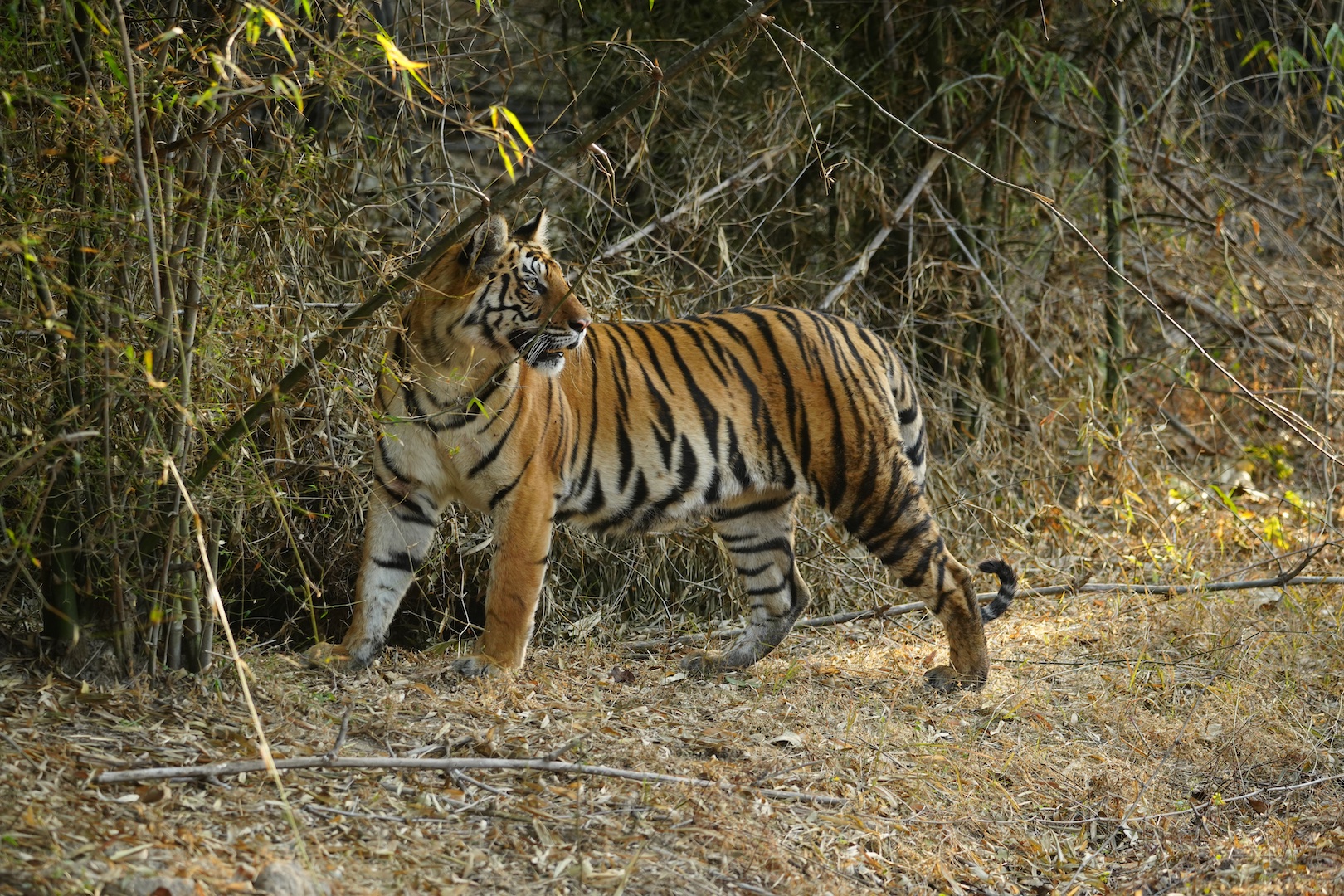
A safari or game drive in central India is just as exciting as anything Africa can offer but by comparison, few people go on safari in India. And that’s a shame because central India is the residence of the Bengal tiger. Bigger and heavier than its African relative, the lion, the Bengal tiger is far more elusive and difficult to observe. As of 2022 estimates, there are only about 3,682 left in their native habitat. Tigers are the major attraction, but central India offers other large mammals—many species of deer, buffalo, and leopards—as well as extensive bird species. Plus, central India is one of the best places in the world to see the sloth bear, which is found nowhere outside the Indian subcontinent.
The conflict between India’s 1.4 billion people and its wildlife is ongoing. Human encroachment on habitat and, historically, trophy hunting caused a dramatic reduction in the tiger population. Project Tiger, a conservation effort started in 1973, established tiger reserves. Each reserve has a dedicated core zone that is free from human habitation as well as a buffer zone. With the support of the Indian government, whole villages had to be relocated, often taking years to achieve. Daily attendance at each reserve is strictly limited, further reducing the impact of human contact.
India commenced tiger conservation by designating nine areas as tiger reserves, but effective management by its National Tiger Conservation Authority has resulted in 58 tiger reserves spread throughout the country, mostly around its center. I visited four of those reserves in January 2026 (Bandhavgarh, Pench, Kanha, and Satpura) with permits that must be obtained in advance.
Practical Considerations
Most reserves open at 6am and close at 11:30am and then reopen from approximately 3pm to 6pm. There are very limited permits issued to organizations providing their own vehicles for game drive transport during normal operating hours and even fewer permits that will allow the vehicle to remain in the park for the entire day. We arose before 5am because most resort camps are a distance from the reserves. It took approximately a half hour to travel from the resorts to the reserves over extremely poor roads.
The early mornings were quite cold. Both my wife and I wore a packable down jacket that could easily be rolled up as the temperature rose to as high as the mid-80s. The afternoon game drive commenced with the temperature in the mid-80s and became colder and colder as the sun went down.
All reserves have very limited resources. Most have only one rest area with lavatories convenient to a particular gate of entry and consequently we only had one comfort stop per game drive. The rest areas in some reserves also contained a souvenir shop and a place to purchase food. Private tour groups providing their own safari vehicles carried their own breakfast and parked in these areas. These vehicles formed a neat row with makeshift tablecloths spread on the hood of the vehicles on which an array of various Indian breakfast dishes were offered. All refuse was collected by the drivers. For the afternoon game drive, a “sundowner” of coffee, juices, and sweets was provided.
Transiting from one lodge to another usually involved a day of travel, and like the parks, had limited opportunity for rest stops. We carried box lunches and ate in the vehicles as we traveled.
Bandhavgarh
Each park had different terrain. There were forests and mountains in Bandhavgarh Tiger Reserve (bandhavgarhtigerreserve.org), which was broken into three zones, each with its own gate. We spent most of our time in the forest zone because it had the most tigers.
In the mountains we ascended a very narrow, winding road to visit an ancient temple to Vishnu. On the second afternoon, we were rewarded with a tiger sighting.
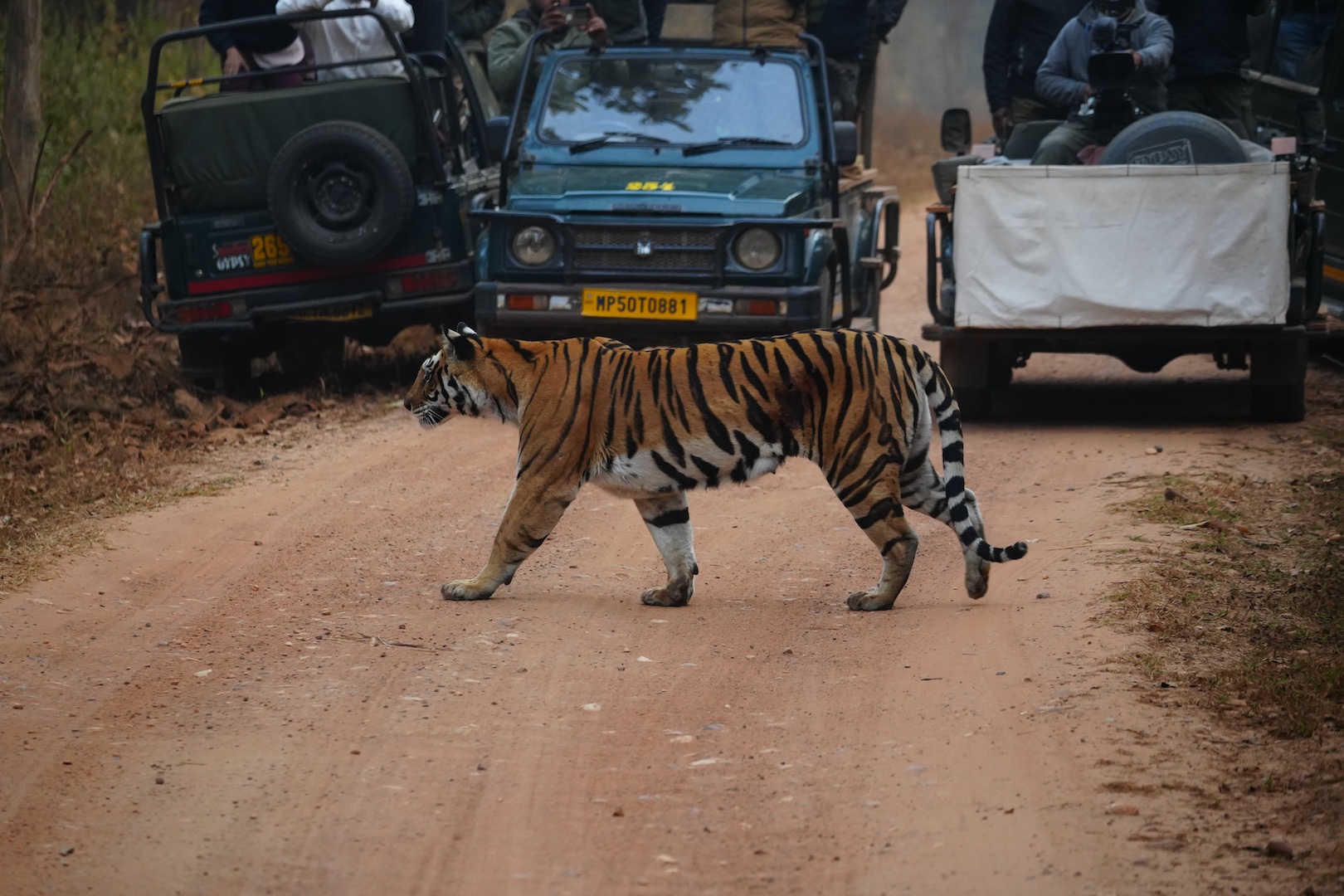
The roads are narrow dirt roads and when a tiger is sighted crossing one, safari vehicles line up in parallel lines facing each other with a clear path for the tiger to cross. If you are lucky enough to be in the first parallel line, you get excellent images of the tiger crossing. Drivers of the safari vehicles are all experienced naturalists from the lodge, but in addition, each vehicle carries a park ranger who is also a naturalist and enforces the ban on using cell phones. The ranger looks for tiger tracks to determine when a tiger passed and where it was headed, and the naturalists listen for the danger cries of the deer and other animals that herald a tiger. After a couple of days, we began to recognize those cries and interpret the tracks ourselves.
Kanha
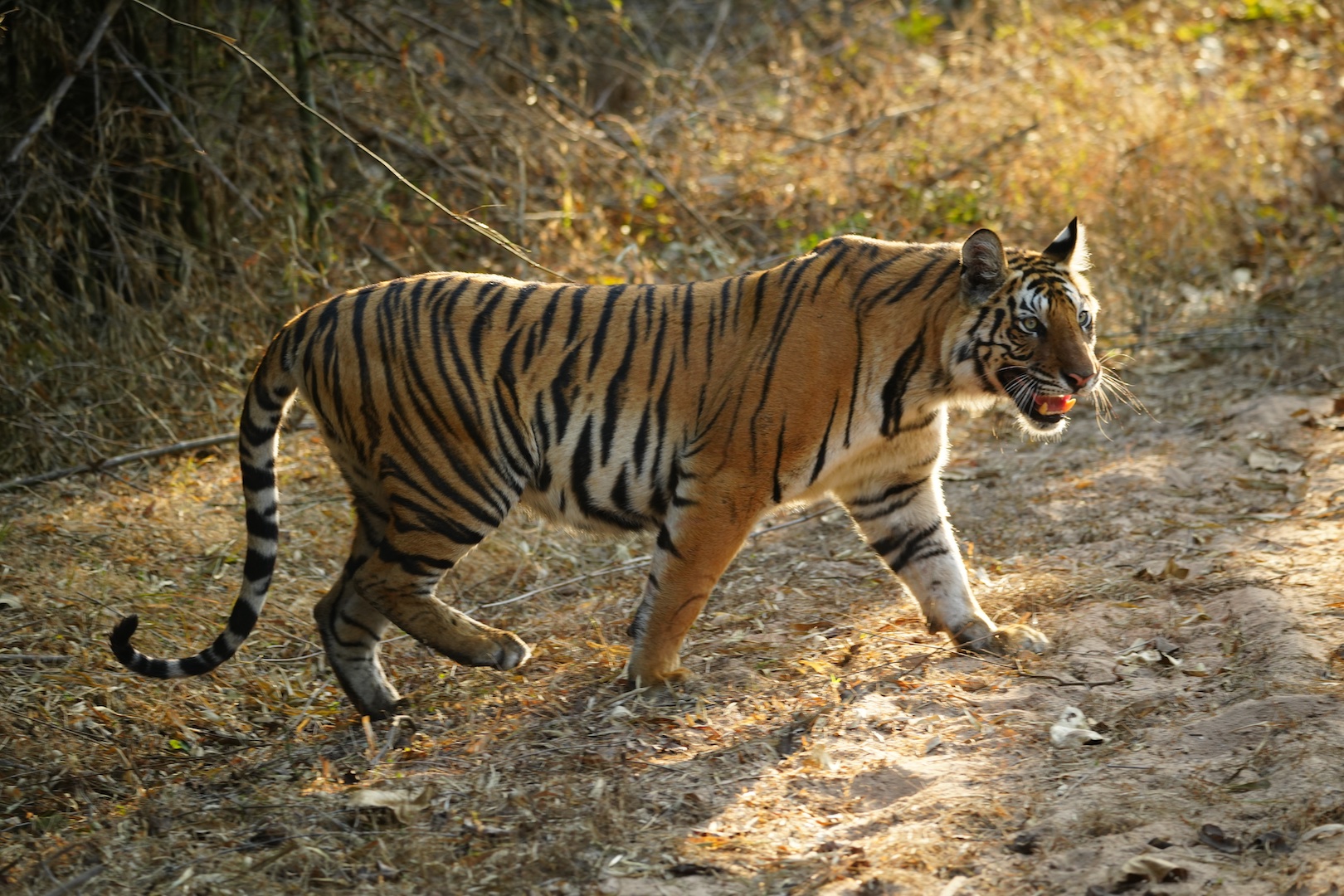
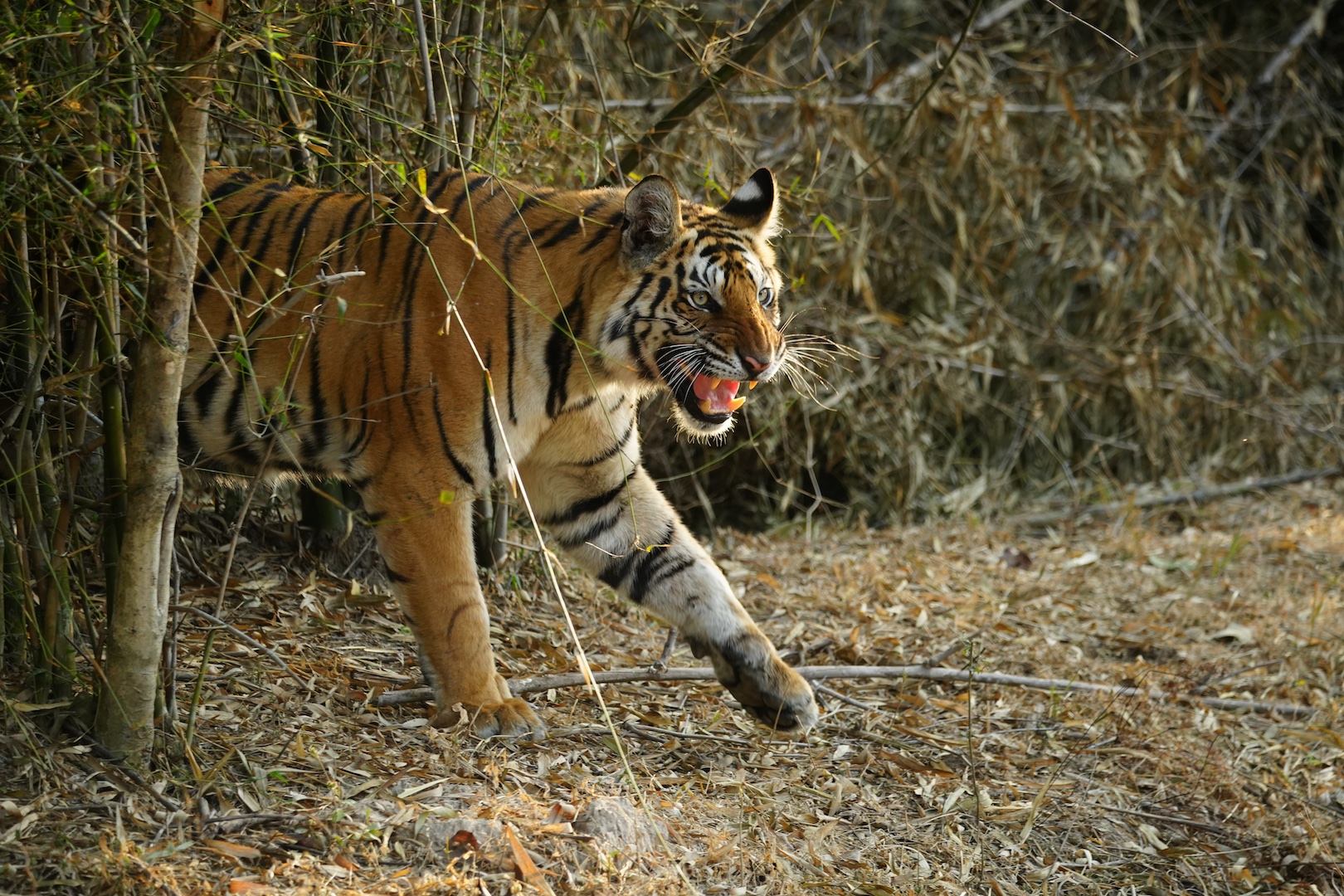
The second park we visited was Kanha Tiger Reserve (kanhatigerreserve.org) approximately 150 miles from Bandhavgarh. It contained some beautiful landscapes and birds galore and was divided into zones, each with a separate gate. We stayed mostly in Zone 1, which had a reputation for having the most tigers. On our second day we sighted a tiger and the park naturalist shouted in amazement: “That’s T-32!” He went on to say that T-32 is a 12-year-old female tiger beyond her cub-bearing years with a bent tail from an old mating incident. She’s now a very elusive tiger and hadn’t been spotted for five months.
It was at this park that we got a real taste of tiger-human conflict. On our second night, we were informed that while we slept, a tiger had killed two cows at an adjacent home. As we left for our morning game drive, we passed by the bush where the tiger was feasting on one of the cows. This was scant yards from where we were sleeping! This is not an unusual occurrence, and the Indian Forest Service will pay the villager for the cows so that he can purchase others. Villagers are encouraged to keep their livestock inside during the night, but that is difficult due to the small size of their houses.
Pench and Satpura
After leaving Kanha, we visited Pench National Park (penchnationalpark.com) and got lucky. We were fortunate to see a mother tiger shepherding her cubs and also spotted a leopard in a tree.
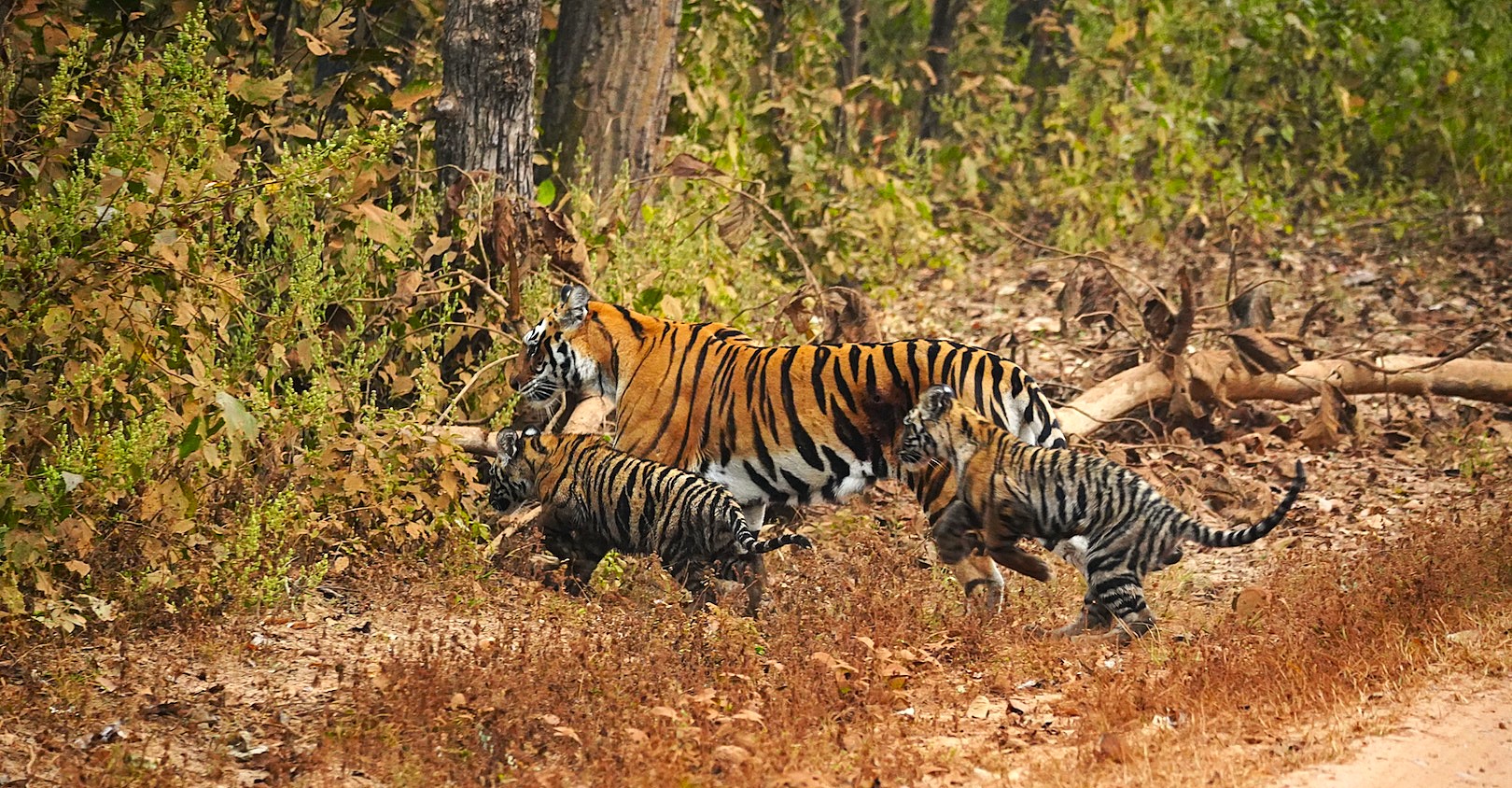
Tigers become even more elusive with cubs, and cubs remain secluded in the brush while the mother hunts. The naturalists can distinguish between the type of tiger calls and can decipher when a mother tiger is calling her cubs, usually because she is on the move to a different portion of her territory or when she has made a kill.
The last park we visited was Satpura Tiger Reserve (satpuratigerreserve.org), part of an immense, connected landscape of more than six million acres, linking forests across districts. Its unique ecosystem provides vital habitat for tigers as well as leopards, sloth bears, Indian bison (gaur), and rare Indian giant squirrels as well as 300 species of birds. In addition to its ecological value, Satpura has strong archaeological significance. Numerous rock shelters offer insights into early human history with paintings estimated to be up to 10,000 years old.
We booked our 18-day trip in February 2026 through Wilderness Travel (wildernesstravel.com) for a cost of $17,360 for two. Wilderness Travel has a sliding scale of trip cost depending on the number of people registered for the trip. Our group of 14 was a mix of couples and single travelers. Since we were more than 12 people, we paid the minimum cost. Business class airfare was an additional $11,312. Accommodations were individual cabins with full bathrooms, electricity, and Wi-Fi. Some had air-conditioning, all were up to western standards, and the lodges had full bars and dining facilities.
The trip was taxing because of the early wake-up time and the overland travel between parks and lodges, but the parks were not overcrowded due to permit restrictions, improving tiger sighting and photo opportunities. My wife and I have been to Africa on safari three times, but this trip rivaled all of those and should be on the list of anyone who likes seeing animals in the wild.