In August 2025, my husband and I headed to Guyana, country number 46 since retiring in 2006. When people asked, “Why Guyana?” my reply was “Why not?” We had not been there; I had seen documentaries and nature shows highlighting its wildlife, especially birds; we prefer remote, nature-filled wilderness to bustling cities; and from Florida, where we live, getting to South America is relatively easy. Over three weeks, we identified 199 bird species.
Georgetown – Iwokrama River Lodge
We landed in Georgetown, Guyana, after 11pm, and the ride to Cara Lodge (caralodge.com) took 1.5 hours due to poor roads. In the morning, we walked through the market, had lunch at the Backyard Cafe, and visited the Botanical Gardens (guyanago.org/things-to-do/botanical-gardens-zoo), where we saw 25 species of birds, 32 for the day in Georgetown. This city was a mess, with too many cars, crazy driving, and construction everywhere.
The following morning, we flew to Kaieteur Falls (pac.gov.gy/kaieteur-national-park), nearly five times higher than Niagara Falls. Because of the heat, the trail to the falls was exhausting.
The next morning, our flight to the little village of Fair View, a short distance from Iwokrama River Lodge (iwokramariverlodge.com), carried only three passengers. The lodge’s riverside cabins had no air-conditioning, and ours was the only one with hot water. We spotted 28 species of birds on Stanley Lake, visited petroglyphs and Indian Island, and even watched a cricket match.
Atta Lodge – Surama
We transferred to Atta Lodge (iwokramacanopywalkway.com/the-lodge), which was rustic, with no hot water or window screens, but it did have mosquito nets over the beds. The lodge was a 15-minute walk from the Iwokrama Canopy Walkway, whose trail included 200 steps and a very rickety suspension bridge. Unfortunately, we saw no birds from the walkway. The following morning, macaws woke us before our 5am wake-up call. The guides pointed a out black-faced hawk and then, to our delight, a Guianan cock-of-the-rock.
We moved from Atta to Surama (moaa.gov.gy/indigenous-villages/surama) the next day. There is a fine line between adventure and risk, and our first excursion here came very close to it.
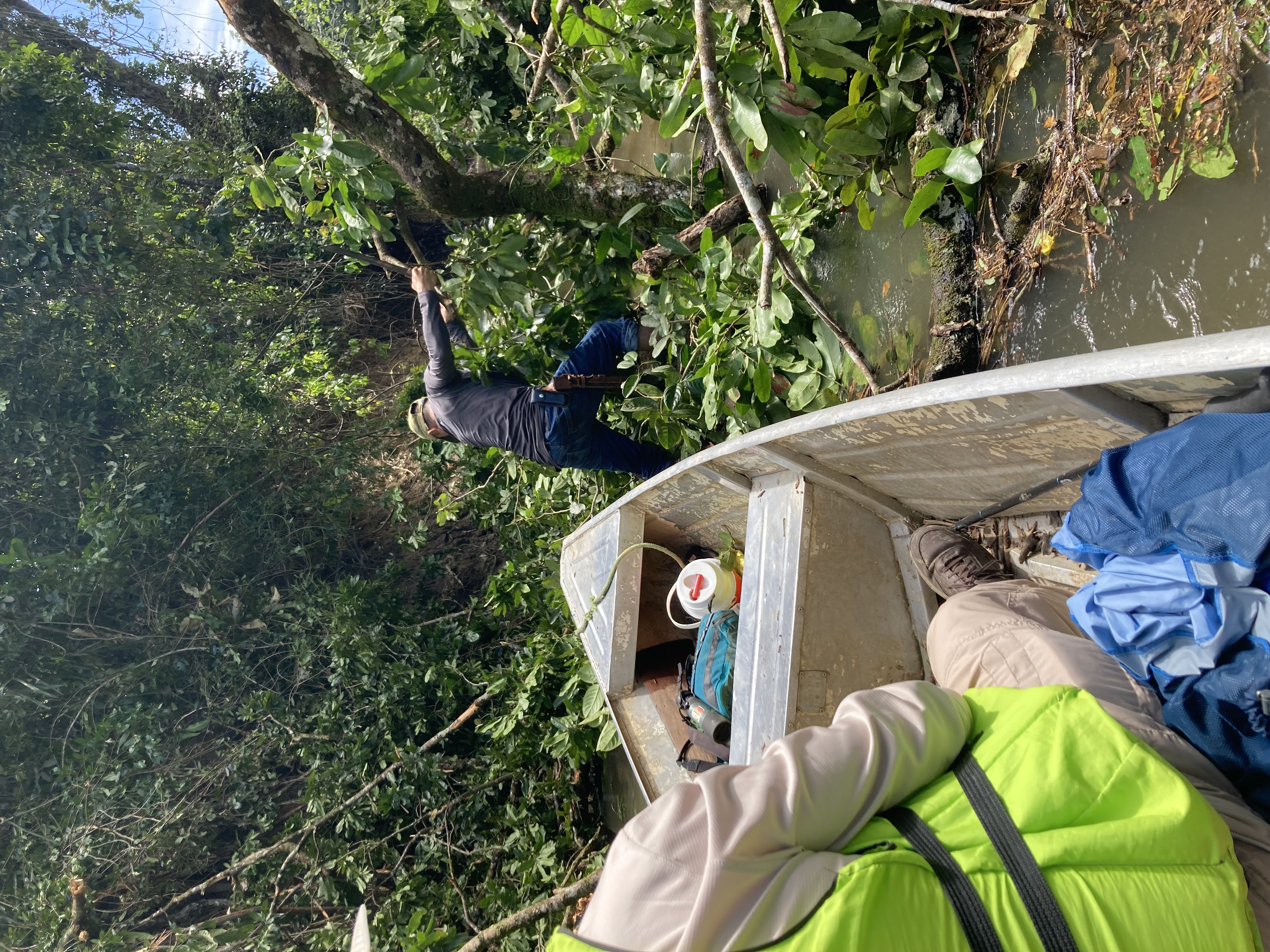
The goal was a harpy eagle nest, and we found it, sheltering a juvenile. Getting there meant walking three miles through the jungle on poorly maintained trails to the Burro Burro River. That took 1.5 hours on foot; then we continued by boat. It was the end of the rainy season, and many trees had fallen. Some had ended up in the river, blocking passage. To our surprise, the captain attempted to gun the boat right over a downed tree. He didn’t quite make it, and our guide Carlin had to get out and pull us over. At other times, Carlin used his machete to hack away at dense foliage until there was just enough room to squeeze through. Once, when the boat shifted, I nearly collided with a tree trunk we were passing under.
Karanambu Lodge
A two-hour drive and a two-hour boat ride up the Rupununi River, passing indigenous villages, brought us to Karanambu Lodge (wilderness-explorers.com/lodge/karanambu-lodge). The Rupununi was wider and more open than the Burro Burro. There were no obstacles as long as we stayed on the main channel.
This lodge was nicer than the last two but still had no air-conditioning or window screens; the Wi-Fi worked, just not at night. We were the only guests and were treated like family. The owners and their daughter ate with us, which gave us a chance to learn about life here over those meals.
Over the next few days, our sightings included the ruby-topaz hummingbird, white-necked jacobin, black-collared hawk, double-stripe thick-knee, wedge-tailed grass finch, fork-tailed flycatcher, brown-throated parakeet, swallow-winged puffbird, and band-tailed nighthawk.
Yupukari – Waikin Ranch
We transferred by boat to Yupukari, where we stayed in Caiman House (caimanhouse.com), opened in 2005 by a herpetologist whose research continues today, funded by lodge revenue. Our first evening, we shadowed researchers looking for black caimans. The community also has a yellow-spotted Amazon river turtle conservation project, which has released more than 6,000 baby turtles.
The following morning, we visited the site that guides identify as El Dorado, the legendary City of Gold. It is just a plateau before the mountains overlooking the vast Rapununi wetlands, where, according to our guide, there was once a British fort and a Portuguese fort close enough to stare each other down. The view was nice, but it’s not a must-see destination.
One afternoon we went out on the Rupununi River by motorboat, then turned around and drifted back with the current. The quiet let us see birds that engine noise usually scatters.
Sightings here included ochre-lored flatbill, silver-beaked tanager, collared forest-falcon, boat-billed heron, burnished-buff tanager, agami heron, rusty-margined flycatcher, and common potoo.
We transferred in a beat-up old truck from Caiman House to Waikin Ranch (waikinranch.com), a 33,000-acre working cattle operation. This was the nicest room we had on this trip, but it still didn’t have hot water, window screens, or air-conditioning.
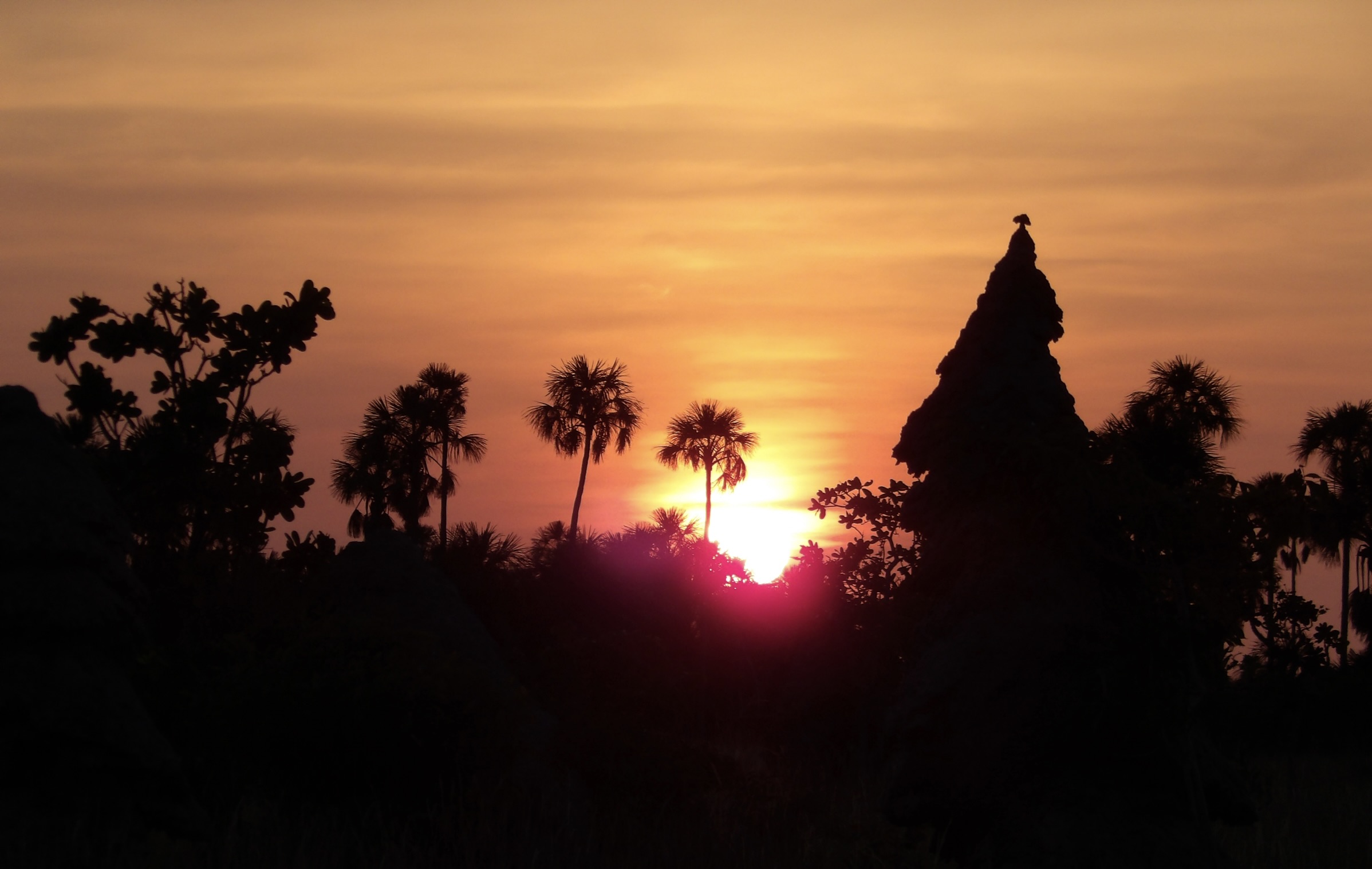
A lovely sunrise greeted us on our way to the Ireng River for a serene canoe ride along the border between Guyana and Brazil. We also visited Termite City. None of the termite mounds we have seen in Africa compares to this: thousands of them, some hundreds of years old.
Sightings here included tropical mockingbird, fork-tailed flycatcher, yellow oriole, yellow-chinned spinetail, and buff-necked ibis.
Lethem – Georgetown – Mahaica River
We drove to Lethem, toured the town, and then flew to Georgetown. Lethem is on the border with Bonfim, Brazil, and we crossed into and out of Brazil without any checkpoints. I found it interesting that the border bridge is engineered to switch traffic automatically between left-hand driving (Guyana) and right-hand (Brazil).
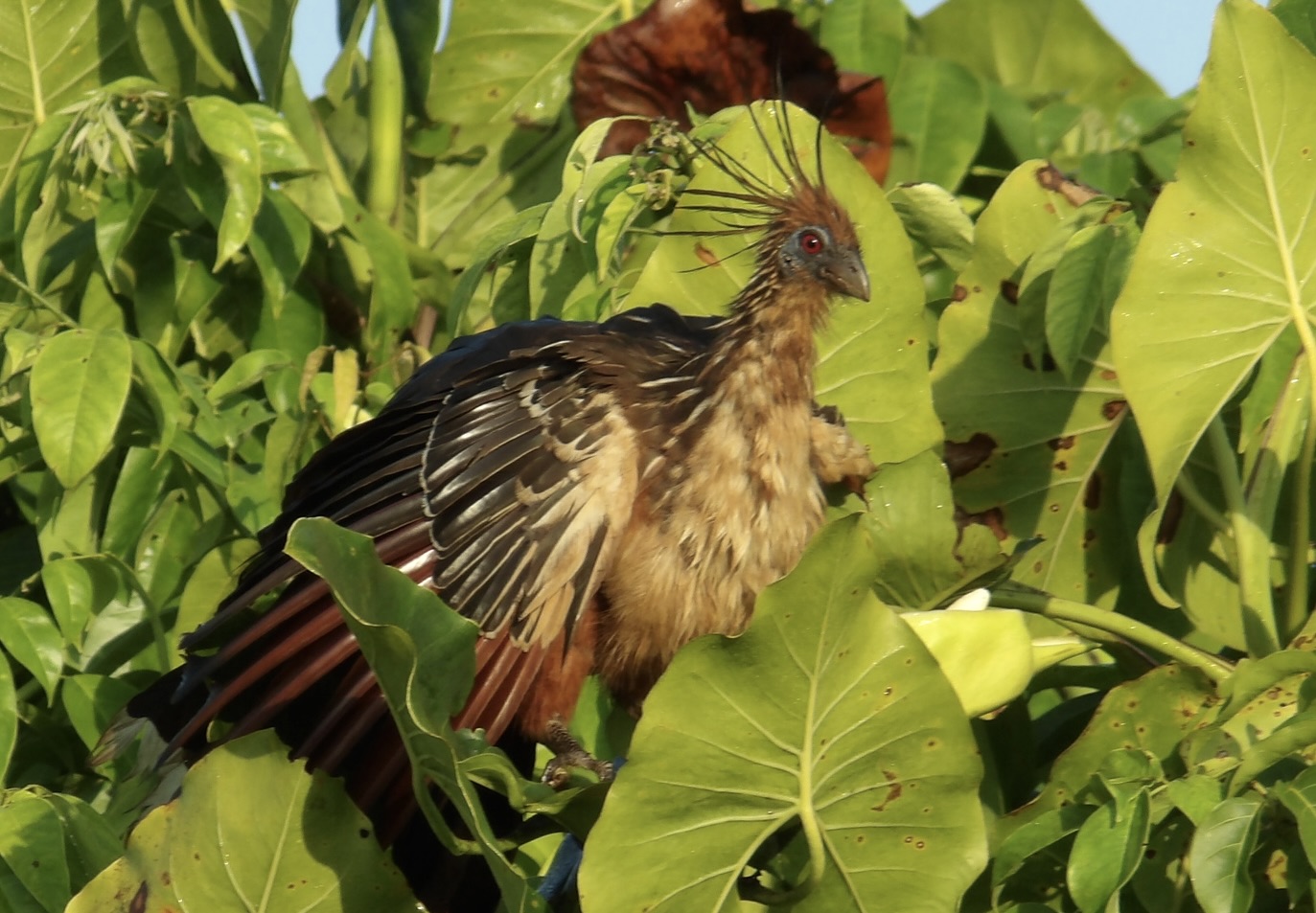
I dreaded the 4am pickup for a 1.5-hour drive to Mahaica River, but it was worth it. Before we had even reached the dock that morning, we had seen 19 species; the boat added 32 more. It was much easier to get good photos from a pontoon boat than from the skiffs we had used earlier.
Sightings here included hoatzin, maguari stork, orange-breasted falcon, magnificent frigatebirds, rufous crab hawk, and scarlet ibises.
Final thoughts
The places we stayed all had decent internet. Yet despite the modernization we witnessed, remote Guyana still lack things we take for granted, such as window screens, hot showers, and decent roads.
Toilets were a constant puzzle and a great aggravation. There was always a secret to getting them to flush.
Our nearly all-inclusive private tour was organized by Natural World Safaris (naturalworldsafaris.com) and cost just under $28,000 for two, not including airfare.