I’m not big on traveling slowly. I need to move—walk, run, bike, poke around, get lost, climb something, meet locals. So, when an opportunity came along to cruise through Burgundy by barge, I was skeptical.
A barge? For six days?
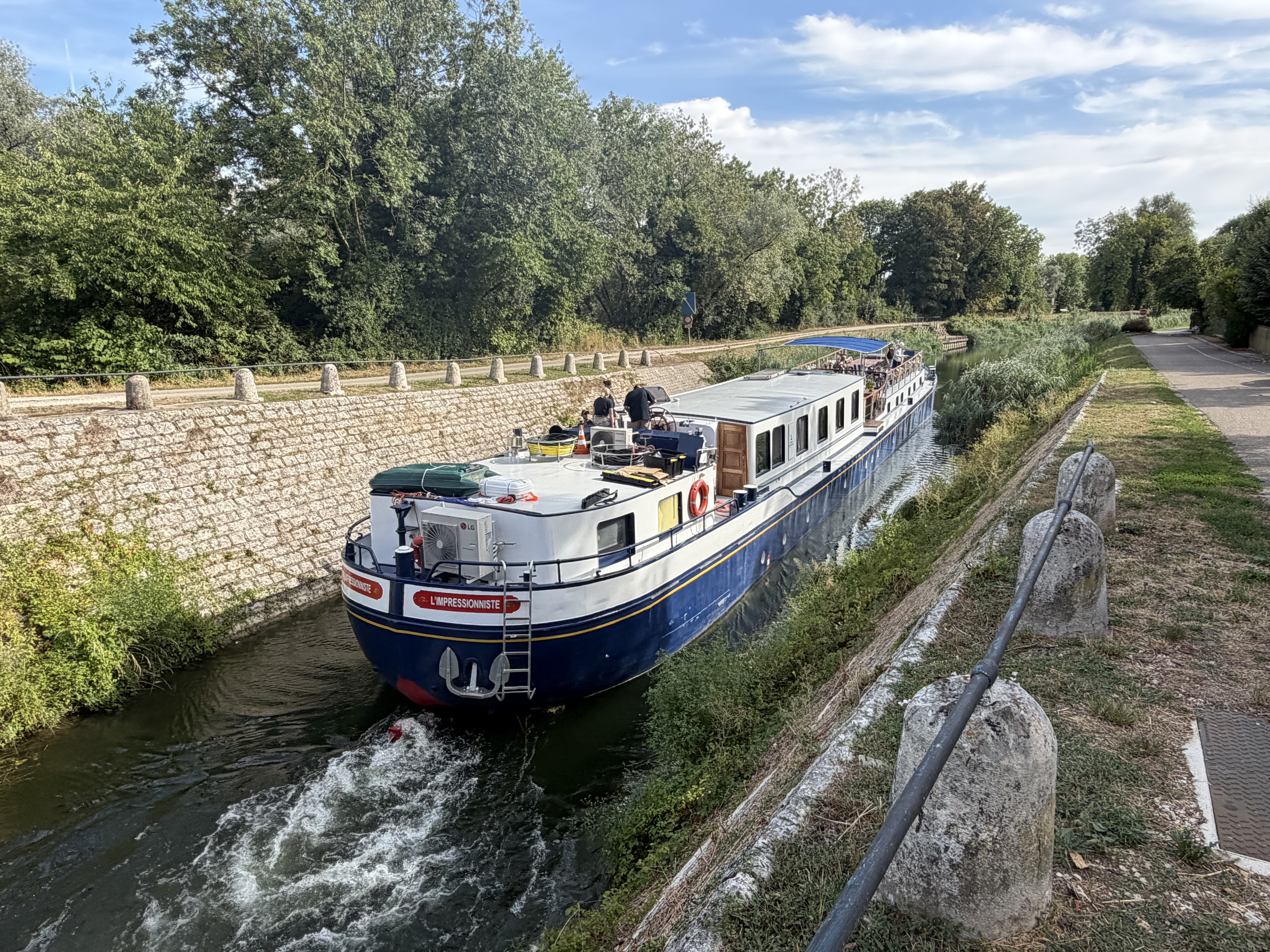
Exploring a region by boat at turtle pace sounded like a version of dungeon hell. Sitting around for hours, perhaps with a glass of wine in hand, watching the scenery glide prettily past? I could feel myself getting restless just thinking about it.
But Burgundy is Burgundy, and so I went.
“I need to schedule at least one long run and several long walks during the week,” I informed Olivia, our cruise director, on my first day aboard, trying not to create a fuss while making it clear that these were nonnegotiable.
“We’ll see what we can do,” she replied sweetly.
It was the kind of answer that should have worried me.
The Rise of Slow Travel
For most of human history, there was no such thing as “slow travel.” There was just travel — and it was slow. Then came the railroad, automobile, and airplane, each shrinking the world a little more.
By the late 20th century, speed had become one of travel’s great selling points: fly farther, see more, squeeze another city, country, or cathedral into the itinerary. I know this kind of travel well.
In 1985, after spending a year as a student in Bordeaux, I joined my family on a bus tour that barreled through France, Italy, Germany, Switzerland, and, I think, Austria — I’m not entirely sure, which tells you something. We saw a blur of Europe: hotels, monuments, and hurried cultural tidbits. How much we actually experienced is another question.
Eventually, a counterargument emerged: What if faster wasn’t necessarily better?
The modern slow movement is traced to Italy in the 1980s, when journalist Carlo Petrini protested the opening of a McDonald’s near Rome’s Spanish Steps. That rebellion grew into the Slow Food movement, founded in 1989 to celebrate local ingredients, culinary traditions, and the pleasures of taking your time.
The philosophy migrated from the table to travel: cover less ground but experience it more deeply. Stay longer. Eat locally. Walk and bike. Meet people. Let the journey itself matter.
Walk and bike? Now that had my attention.
But six days on a barge?
Boarding the Slow Boat
European Waterways’ (europeanwaterways.com) L’Impressioniste was moored at Avanne-Aveney, ready to carry us through Burgundy. Thanks to drought and low water levels along its usual route, we had been rerouted farther east to the Canal du Rhône au Rhin rather than the better-known Canal de Bourgogne.
My husband David and I were welcomed aboard by the six-person crew. Joanna, one of our hostesses, held out a cool white washcloth and a glass of Champagne, a combination that made slow travel seem considerably more promising.
We met our eight fellow guests — Australians, Americans, and British — and soon sat down to our first gourmet dinner: tuna tartare followed by chicken supreme. It was the first of a weeklong parade of beautifully prepared meals, each accompanied by two very good French wines.
This is going to require more than a run or two, I thought.
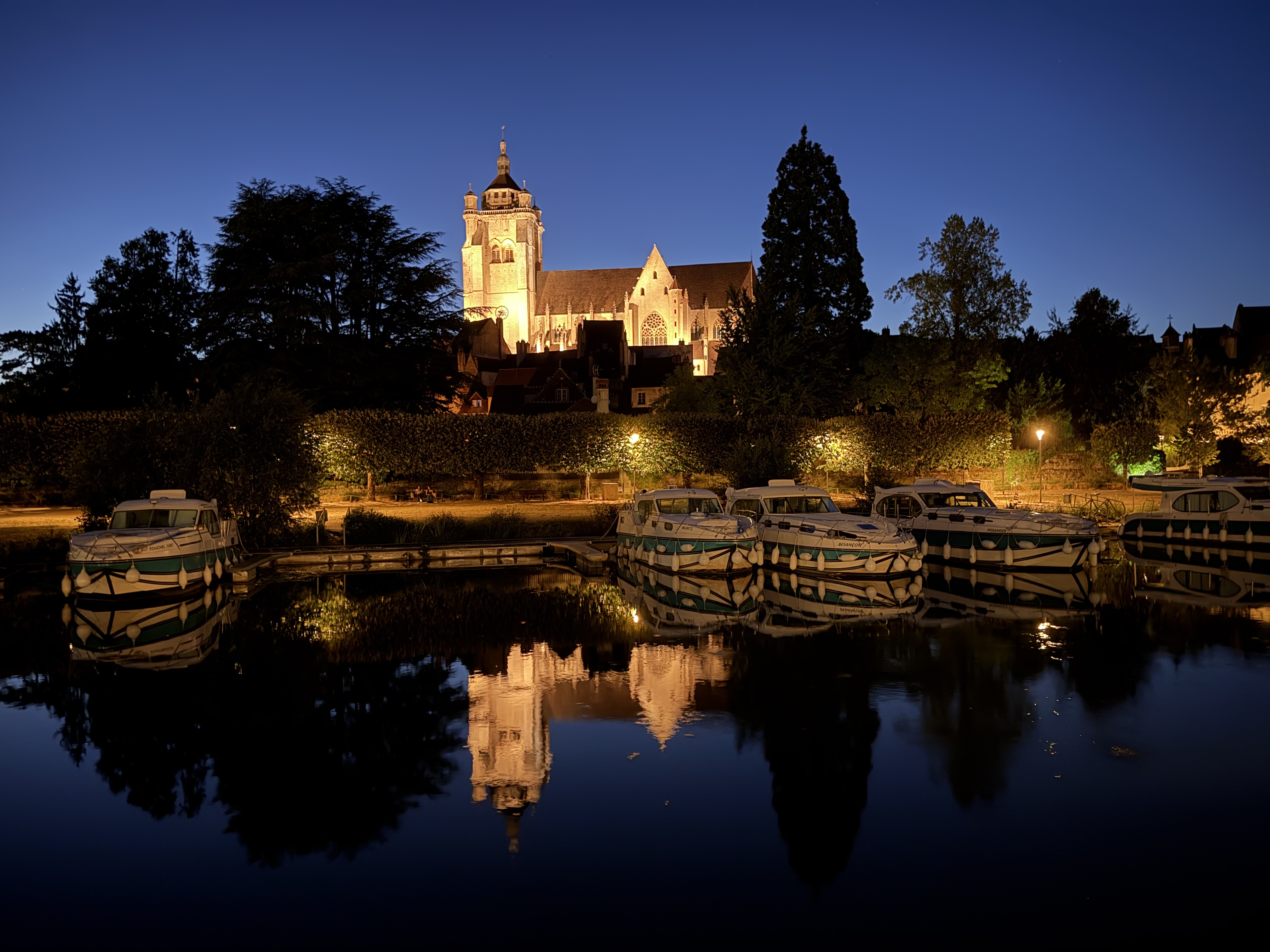
Testing the Waters
The next morning, I awoke to a lurch. The barge was moving!
I rushed up on deck to discover we were slipping through the Tunnel de Thoraise, its darkness punctuated by fairy lights. Emerging on the other side, our pilot executed an intricate series of maneuvers to swing the barge around in an improvised three-point turn.
A couple out for a morning stroll stopped to help, the monsieur catching a rope tossed from the barge and pulling it taut to give us the leverage to pivot.
I watched the crew’s deft maneuvers, learned about canal mechanics, and spotted a religious statue tucked into the rock, dating from 1858. I began wondering about the people who had passed this way before me, and what their stories might have been. As we moved along, I scanned the shoreline for herons, cormorants, anglers, boaters, and people waving from shore. There was always something to see, someone to greet with a “bonjour.”
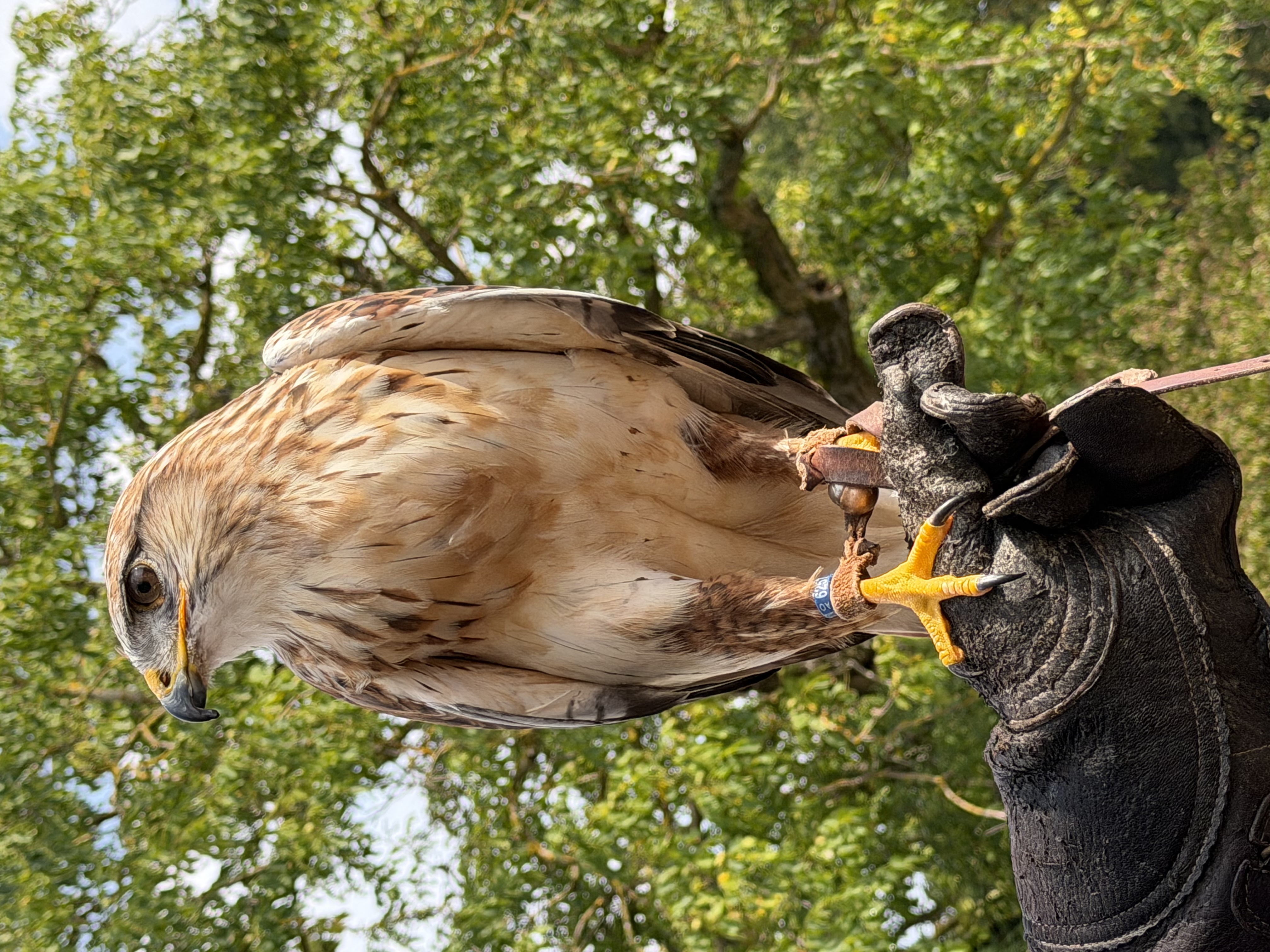
That afternoon, we visited Château de Germolles, the best-preserved residence of the Dukes of Burgundy, where we were treated to a private falconry display on the historic grounds. At one point, a harrier hawk came swooping straight at me, veering away at the last second. Later, wearing a massive leather glove, I held out my arm and suddenly I was face-to-face with another massive hawk.
I hadn’t expected an adrenaline rush from “slow travel.”
Maybe slow didn’t necessarily mean uneventful.
More Surprises Along the Way
At Domaine Jean-Baptiste Jessiaume in Santenay, winemaker Marc Jessiaume introduced us to his biodynamic wines and one of his more unusual techniques: Mozart. He plays the composer’s music during fermentation, explaining the frequency and good energy it creates in the cellar. It sounded eccentric. Then again, the wine was excellent, so who was I to question Mozart?
We explored Vauban’s citadel in Besançon, tasted more wine at Domaine Chanson, wandered Dijon and Beaune, and strolled through flower-bedecked Dole, where we came across the birthplace of Louis Pasteur.
The days developed a rhythm. Cruise awhile. Get off. Explore. Eat extraordinarily well. Watch a lock open and close. Wave to someone on shore. Pour another glass of wine. Go somewhere I might never have thought to visit on my own.
And somewhere in that rhythm, something else happened: The ten of us began to feel less like fellow passengers and more like friends. Maybe it was the hours around the dinner table, or the wine, or simply having nowhere we needed to rush off to. We laughed — a lot. We traded stories. We got to know one another in a way that rarely happens when everyone is racing to the next sight.
Gradually, I realized the barge wasn’t keeping me from Burgundy. It was giving me a different way into it.
And That Run?
Ah, yes. The run.
I certainly didn’t get as much exercise as I would have liked. And given the delicacies coming out of Chef Robert’s kitchen, I definitely felt it.
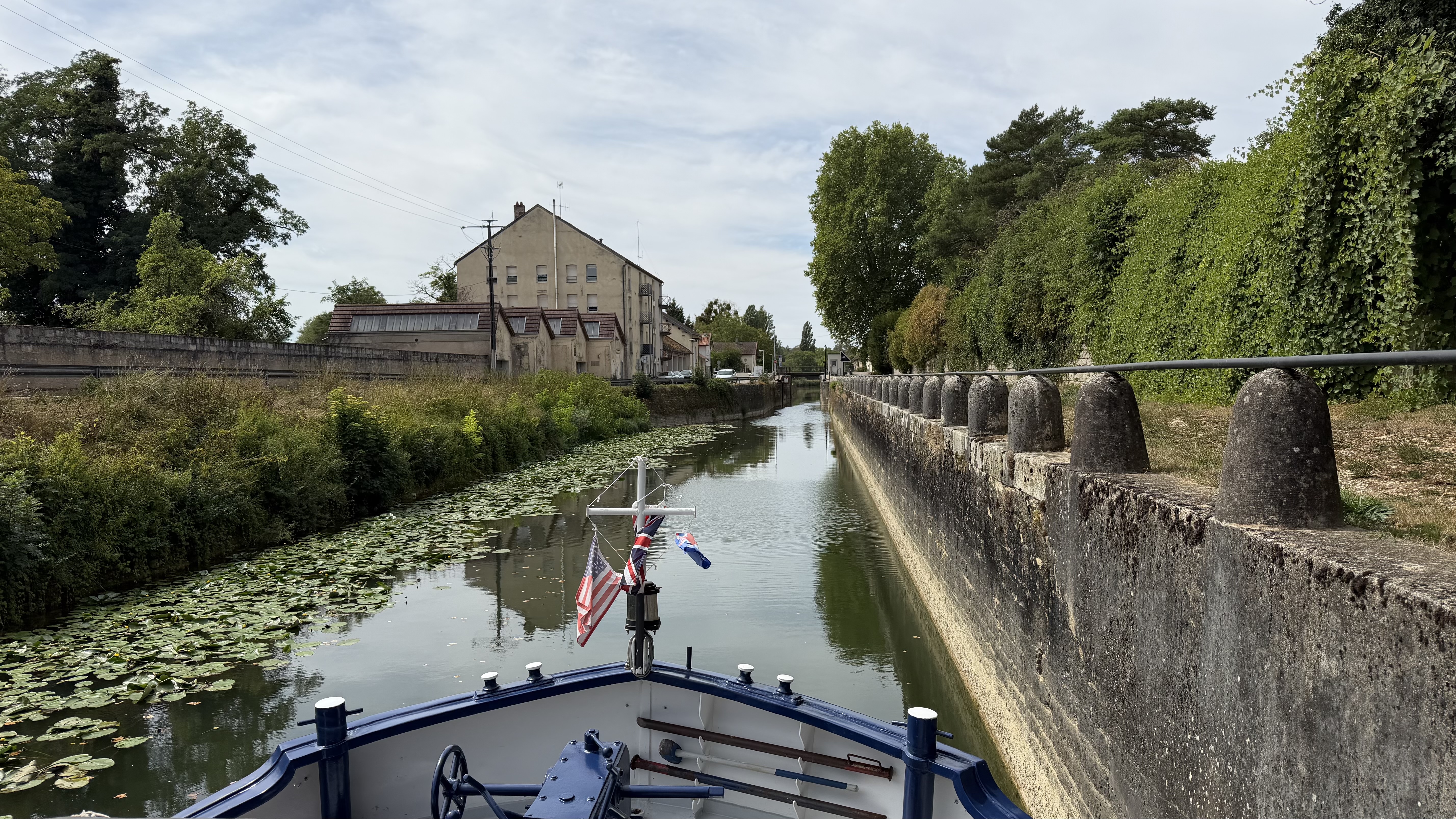
One afternoon, we had the chance to bike along the canal and meet the barge again about five miles down the towpath. The bikes were clunky — one even had a broken fender that David fixed with a shoelace — but my body loved the sudden rush of exertion as we sped along.
After the short bike ride, I fit in a run. Not the long one I had so firmly informed Olivia I needed, but a little one along the towpath, the canal beside me and L’Impressioniste inching somewhere behind.
As I finished, I slowed to a walk, taking in the arch of leafy trees overhead, the canal’s glittering green waters, gardens abloom with flowers, a friendly neighborhood cat.
And I realized I wasn’t in a hurry to get anywhere.
Apparently, Olivia had been right. The runs were negotiable after all.
Barbara Noe Kennedy is an award-winning travel journalist, author, and former longtime senior editor at National Geographic Travel Publishing whose work on culture, history, food, and wine appears in BBC Travel, Travel + Leisure, Fodor’s Travel, and National Geographic Travel. Learn more at barbaranoekennedy.com.