
by Herschell Gordon Lewis; Pompano Beach, FL
My odyssey to three of India’s major tiger reserves had an inspirational base. My wife, Margo, and I had visited the tiger sanctuary at Chiang Mai, Thailand, and it had been an exhilarating experience. I’ve proudly shown to anyone who would take a look a photo of myself hugging a full-grown tiger.
And how, you might ask, is that possible without its being the last pose of my lifetime? The answer is in the Chiang Mai operation, itself. It’s a breeding program specifically designed to increase the tiger population, so they baby the tiger cubs, pampering them like kittens. As a result, the tigers become used to people and don’t mind being physically touched by them.
That is, until they’re two years old. At that age, their basic nature begins to surface, and within a short while they become tigers. However, they’re full grown before they turn fierce, and they truly are huggable.
Armed with that experience, we decided to visit three of the leading tiger reserves in another country, India, knowing that none of the tigers there would appreciate a human hug but also knowing that the experience would be considerably more genuine than the hyper-controlled context at Chiang Mai.
Getting there
So off we flew, with stops scheduled at Kaziranga National Park in the Assam sector of northern India; Kanha National Park, near Nagpur, and Bandhavgarh National Park in the Central Indian Highlands.
Our trip was set up, with their usual precision and efficiency, by Asia Transpacific Journeys (Boulder, CO; 800/642-2742), through which we have arranged tours for 20 years. The itinerary was implemented by the equally resourceful Travel Scope, headquartered in Delhi.
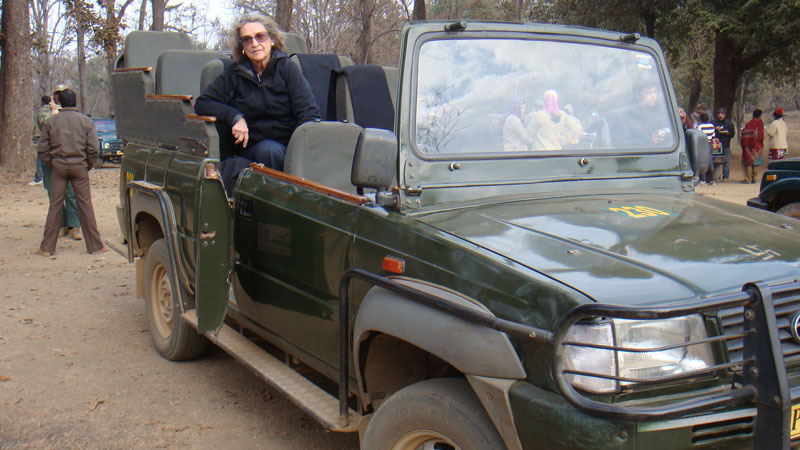
Getting to Kaziranga demands both patience and a well-padded rear end. We flew to Guwahati, in Assam state, on a SpiceJet flight. There we were met by a pleasant young man who escorted us to a car that jounced us for between four and five hours to the park. There’s no way around this; if you want to get to Kaziranga, you have to drive (and drive and drive).
Finally we arrived at Diphlu River Lodge, where we were met by attentive staff, and walked down a grassy path to one of the cottages on stilts. Our room was comfortable, although (typical of rooms these days) it didn’t have enough lights. Meals were served in a well-appointed dining room, the machan (jungle platform), again with an ample and courteous staff. There was enough variety of cuisine to satisfy almost every taste.
One caution — there are stairs everywhere and no wheelchair ramps. If you have a bad back or a problem climbing stairs, this place is not for you.
So much for the ambiance. Now on with the show.
Into the wild
Margo and I spent three nights at Diphlu, but we had just two days of safari in Kaziranga. After breakfast the first day, we clambered into an open jeep, staffed by a young naturalist and a driver, and off we went into the park for our morning excursion.
Driving down rutted paths, we saw placid antelopes, wild pigs, lumps in the distance that our guide said were otters, a pair of far-off rhinos and many species of birds, including kingfishers and eagles. If we were dedicated bird-watchers, the session would have been more exciting than it was for us. If any tigers were lurking in the grass, they were camera shy enough to remain hidden.
Then we headed back to the lodge for lunch.
The afternoon safari was on elephantback. Sitting atop an elephant is, in itself, enough reason for happiness, but an even more profound reason for our joy was plodding close to a rhino and her baby, then near a big, old rhino that didn’t care at all that an elephant with a couple of naked apes on its back was tromping through its territory.
Suggestion — if you book an elephant ride, ask to sit astride, not sidesaddle. You’ll see more, be more comfortable and be able to take better photographs without wrenching your spine.
The second day wasn’t as exhilarating, as both the morning and afternoon safaris, in the jeep, showed us nothing we hadn’t seen the day before. In fact, the dusty trails were so jammed with jeeps that halfway through the afternoon we told the driver to take us back to the lodge.
The next morning, back we went on the torturous drive to Guwahati.
Though the service and attitudes in this area were excellent, the wildlife exposure was so-so.
Kanha National Park
Our second stop was Kanha National Park, and just getting there was an adventure. The day started with a lengthy drive to the airport in Guwahati for a flight to Mumbai, where we stayed overnight in the luxurious Leela Mumbai.
It was a short night, though, because the flight to Nagpur, on a Jet Airways plane that seemed to have about two inches between the rows of seats (more than 200 seats on a 737), left at 6:55 a.m.
From Nagpur to Kanha it was a 7-hour drive! Part of the trip was on respectable highways, but a lot of it was on pothole-rich, single-lane roads that weren’t friendly to our backsides. Eventually, we pulled into Banjaar Tola, a posh new “tented” camp at Kanha run by the famed Taj Hotels Resorts & Palaces.
As you’d expect at any Taj property, this camp is pure luxury. The accommodations are called “tents,” but they’re permanent and spacious. Each has a balcony where you can recline and look over the vista, and you can dine in the dining room or ask the personal butler for service in your room or on the balcony. (Yes, each suite has a butler; open the sliding front door and your butler is there, waiting for instructions.)
So, from the viewpoint of luxury, guests at Banjaar Tola have it made.
The same enthusiasm can’t quite be applied to the park. Dozens of “tiger lodges” surround the park, and in the early morning a convoy of guest-laden jeeps crowds the entrance to Kanha.
Want to see a tiger? Well, okay. From a central dispersal point, officials send carload by carload to a place near where a tiger has been seen resting in the high grass. There, three elephants wait patiently.
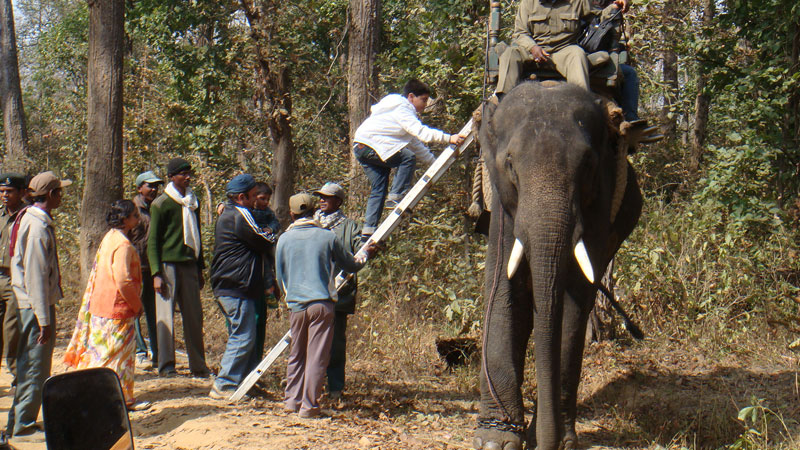
Visitors climb aluminum ladders (really!) to sit on an elephant, then a mahout guides each elephant, loaded with two to four tourists, about 50 meters to the location where it’s possible to see something of the recumbent tiger and much of the high grass. Then the mahout turns the elephant around and, back at the starting point, travelers climb down the ladder and give way to the next group of elephant-climbers.
Elapsed time? About four minutes. But the visitor can say, “I saw a tiger!”
Then came an afternoon drive, which added a different viewpoint to any negative reactions we might have had earlier. As we rode in the open jeep over thousands of densely wooded acres, I felt that the absence of tigers and leopards could be seen as a positive.
These animals lurk deep in the forest, and the trails for human visitors are laid out to protect and preserve their future. (Only 30% of this park is open to the public.) So, while populations of other threatened species may decline and disappear, maybe these animals will survive because their habitat isn’t so accessible.
While pondering the pros and cons of traveling someplace where the desired sightseeing may or may not come to fruition, we moved on to Bandhavgarh, enduring another jouncy 6-hour ride in an SUV.
Bandhavgarh National Park
Bandhavgarh is the bellwether of Indian game parks. It has the highest density of tigers of any park in India, which correctly implies the greatest number of visitors.
Our home for four days was Mahua Kothi, the longest-established park property operated by Taj Resorts (Kanha is the newest). My first impression of both Bandhavgarh and Mahua Kothi was a mixed one. We were at the most famous resort in the most famous game reserve, but a mild shabbiness lurked over the scene.
Typical of Taj properties, the staff was courteous and eager to please — so much so that when we asked why lighting in our room was dim, an attendant quickly replaced some of the bulbs with stronger ones. A collection of soiled garments went into a bag for laundry service with next-day delivery (included).
The negatives? The furniture was handmade of primitive materials, and only one chair sat in the room. The bathroom was old-fashioned. At dinner, the walk to the dining hall was in the dark, and although somebody was assigned to be our “butler,” he wasn’t on hand, so we used our own flashlights to find our way to the dining hall (where, of course, every meal was Taj-perfect).
Meals were served at two big tables. For ease of conversation, one table seemed to be for English-speakers and the other for those who preferred to converse in Hindi, so the ambiance here wasn’t a major factor.
The next morning we were off at 6 a.m. to look for tigers, with just as knowledgeable and helpful a naturalist (who also was our driver) as we’d had at Kanha.
The early drive was set to last until about 12:30. Oops! It turned out to be a mirror image of our experience at the previous resort, with our sole view of a tiger being that of one lying supine in the grass, again seen from elephantback. We saw lots of monkeys, antelopes and birds but no other tigers.
The next day we saw only a few antelopes and some birds; there was not even an elephant ride to see a recumbent tiger only because the early-morning scouts couldn’t find one. A 4-hour drive didn’t flush one out for us, either.
Oh, well. You can’t expect a tiger to appear on schedule.
Summing up
Our all-inclusive, monthlong custom tour cost $16,045 per person, including all accommodations, meals, tours, entrance fees, chauffeured land transportation and travel insurance with emergency-evacuation coverage. It cost an additional $2,533 per person for the seven internal flights. International airfare and visas were not covered. We enjoyed outstanding attention, value and gratification per dollar spent.
Each of the three camps/resorts at which we stayed had a uniqueness. For attention and courtesy, the Taj resorts were on top. Attention and courtesy are the very basis of their operating philosophy.
If you want to be sure you see some big game, I’d say Diphlu River Lodge has the edge. You’re sure to see a rhino, and, although tigers are scarce there, the odds of spotting one appear to be no worse than at the more expensive parks.
Would I go back? Probably not if, for the same dedication of time and money, I could revisit the tiger-breeding station at Chiang Mai, Thailand, and hug another of those majestic animals.
(See reader's letter "Wildlife not guaranteed," Jan. '13, pg. 56)
Similar articles
-
 October 2026
A Tiger Safari in Central India
-
 November 2021
Southern India with OAT
-
 September 2021
Madurai in southern India
-
 April 2012
Ladakh — reaping the rewards of a private tour in this remote northern India region
-
 February 2012
… two bits
-
 October 2011
Chaos, color and camels on a tour of Northern India