: I have always wanted to visit Papua New Guinea. I was recently talking about this dream with my children and they strongly discouraged my pursuing any solo travel plans because they say it is so dangerous. Is this true? Do you think it would be safe for a “mature” single lady to visit solo?”
: If you are the type of traveler who must be able to wander off on your own, then by all means do NOT visit Papua New Guinea (PNG). This is a country where in many areas it is just not safe to walk on the streets.
I was in Port Moresby, Mount Hagen and the Western Highlands Province of PNG in December ’02, invited by the American Ambassador to train medical personnel in counseling sexual assault victims. Your children are right. It was by far the most dangerous country I have ever visited (and I worked with refugees just outside of Mostar, Croatia, during the last war!).
Having acknowledged the danger, which is significant, I would still visit this spectacular country. I would, however, do so with much more caution than anywhere else I have traveled.
Port Moresby, the capital city, was by far the most dangerous part of the country. I was told not to walk outside day or night because of the danger of the “packs of rascals” (gangs of men). This rule held for the men as well and we all followed it as a RULE, not a suggestion.
Since there are no roads connecting Port Moresby to the countryside, and there is an estimated 85% unemployment, when villagers who have saved the money to fly into town do not find work, they cannot return to their villages and they unfortunately resort to crime. The targets of crime are not necessarily foreigners; locals are targeted as well, and while they must travel on foot during the daytime, they too avoid being out after dusk.
The one evening we drove back from a restaurant at night, the only people we saw out were men, in groups, and all were carrying machetes.
In the cities, homes are each surrounded by a tall fence topped with barbed wire, with a guard at the gate. Restaurants have a compound around the parking lot, with a guard. You drive into the locked compound, where you get out of your car and then pass through additional security to get into the restaurant.

Unfortunately, Port Moresby raised the threshold for what I consider dangerous by several degrees! I would also recommend you avoid spending any unnecessary time in Port Moresby. The highlands are much more interesting and much less dangerous.
You likely will fly into Port Moresby, where, as I found, the Airways Hotel is very nice. It is located inside the airport compound, then surrounded by an additional guarded gate. They also have one of the best restaurants in the city, Bacchus, conveniently located within the Airways Hotel security area.
I flew from Port Moresby to Mount Hagen in the Western Highlands. While Mount Hagen is also a city where you should be very cautious, it is much less dangerous than Port Moresby. Mount Hagen is also an area where you will want to have reservations ahead of time. Your hotel should meet you at the airport and take you to your accommodations. While there are public buses, they are old, crowded, unlabeled and definitely not recommended.
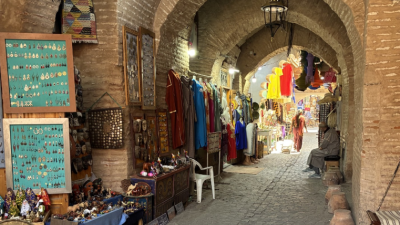
I did not see any cabs, and I also would not recommend a rental car because of the safety issue and because the roads are extremely poor and unmarked. I did feel comfortable walking through the Mount Hagen market, taking the usual precautions.
I stayed at a lodge in the hills about 45 minutes out of town, Haus Poroman (P.O. Box 1182, Mt. Hagen, Western Highlands Province, Papua New Guinea; fax 675 542 2207, e-mail hausporoman@global.net.pg), and would highly recommend it.
The owners did not originally intend to open a lodge. Initially, they opened their home to friends, then backpackers who found them. Eventually, they decided to build additional buildings and open the lodge to the public.

Up to 20 guests stay in grass huts, just like the local villagers; however, unlike the local villagers, guests have running water, showers and flush toilets. It is extremely comfortable, with good food and friendly management.
If possible, plan to be there on a Friday night when the staff typically invite interested guests to join them at the Mount Hagen Club in town. The local “expats” gather at the club at this time. Everyone is friendly, welcoming and talkative. I met Australians, Brits and others who moved to PNG up to 32 years before. Their stories were fascinating and a highlight of my visit.
I also met the local “celebrities,” the relatives of Mic Leahy, an Australian gold miner and the first white man to come to the region in 1937. Prior to that, the tribes had never seen a white man and did not know there was anyone outside of their highlands. They thought Mic was a spirit of their ancestors who had come back to Earth!
Once I got out into the countryside, I felt comfortable wandering around on my own, during the daylight hours. The people in the village where the lodge is located were very friendly and welcoming and were glad to take me up and down the rather steep paths connecting the hilltops over which their tribal village was spread. Since English is the official language, those who have gone to school speak English fluently.
While the villagers now wear Western shorts and T-shirts and some work for wages in Mount Hagen, most continue to live a subsistence lifestyle, much like they did before Mic Leahy came to this area. Their homes are made from local grasses, and each family maintains a garden where they grow most of their food.

They may also eat a chicken or pig on special occasions. Chickens are expensive, however, selling in the local market for the equivalent of over US$4, which is more than I pay, and theirs still need to be butchered and plucked.
PNG is a patrilineal society in which only the men inherit land, and each must marry a woman from outside of their tribe. The men still pay a bride price, which will include chickens, pigs and a cassowary bird.
The staff at Haus Poroman will also arrange for a car and guide to take interested guests to visit several highland tribespeople who perform sing sings. I would not miss any optional side trips to see the mud men, skeleton men or other tribes, as it is truly like stepping into National Geographic.
The Mount Hagen Show, the second weekend in August each year, includes nearly 100 tribes performing a sing sing. There could be 300 to 400 tourists in town, in addition to locals, to witness the event.
This is definitely a country where travel required all of my usual travel precautions, such as leaving all jewelry and expensive-looking clothing at home, plus many additional considerations and restrictions. It significantly limited my usual independence.
Was it worth it? Absolutely!