My husband Lynn’s favorite movie is “Casablanca,” and even knowing it was all filmed in Hollywood, he has wanted to visit Morocco for years. Once I began my research, I learned that Casablanca is by all accounts a very industrialized city: reviewers suggested we head instead to Marrakech, with its ancient walled city center, great food, and good tourism infrastructure. Thus, we headed off on a seven-day trip to Marrakech and the surrounding area in early May 2026.
Because of travel plans after Morocco, we flew into Lisbon and then took a direct one hour-and forty-five-minute flight to Marrakech via TAP Air Portugal (flytap.com). Having reserved all lodging within the medina (the original walled old city) I had some concerns about ground transportation to our lodging as cab drivers expect to be paid in dirham (the local currency). Fortunately, just to the right outside the airport, there is a taxi service that accepts credit cards; the taxi fare was approximately $38.
Marrakech
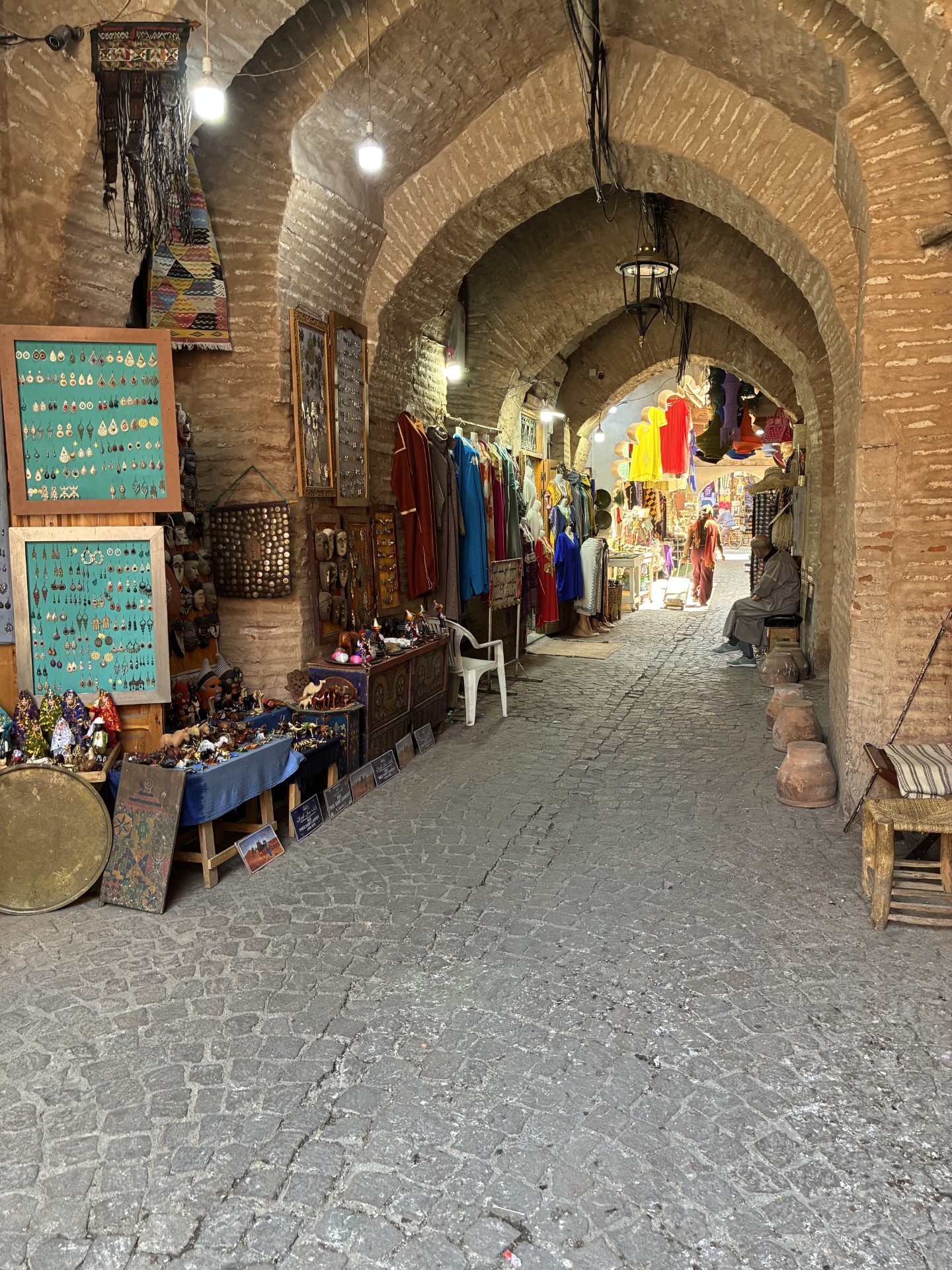
Twenty minutes later, we arrived at the medina. Unbeknownst to us, taxis aren’t allowed inside the walls, but fortunately our hotel, La Maison Arabe (cenizaro.com/lamaisonarabe/marrakech) was close enough to the entrance that the taxi driver could walk with us to the door.
The hotel was lovely, showcasing flamboyant Moorish architecture of ornate arches, fountains, and gardens. Its décor featured deep shades of red and gold, complete with pillows, colorful tiles, and Persian rugs. Wonderful staff spoke impeccable English. We were led to an intimate room and served fragrant hot mint tea, poured from a teapot held several feet above our cups. (We later learned that in Morocco, the more welcome the guest, the longer the stream of tea from its pot.) Accessing our room, we noted that both the bed and the bathroom floor were sprinkled with red rose petals.
La Maison Arabe was $210/night, and has an excellent restaurant: In fact, cooking classes are available. Our outdoor table overlooked the hotel’s gardens and pool (closed to swimming after 6pm), creating a very tranquil environment. Our salad and lamb tagine dinner accompanied by wine and dessert (total bill, with tip, around $85) was delicious and served by an excellent waiter.
First on the agenda the next day were the souks--stalls within a sprawling ancient marketplace that dates from the founding of the city around 1071. We have explored similar markets in Egypt and Turkey, but along with the small shops crowded with tourists and the occasional donkey, this souk allows motorcycles to enter… and there are lots of them competing with the shoppers for space in the narrow passageways. This was unnerving at first, but we soon learned that as long we walked in a straight line, the cyclists maneuver around us.
We found the vendors to be enthusiastic but not aggressive; but do be aware of the enticements into the rug emporiums. Our explorations in the souks was unassisted. We found a nice rooftop terrace to enjoy a soda and then made our way to the city’s main mosque, the Koutoubia.
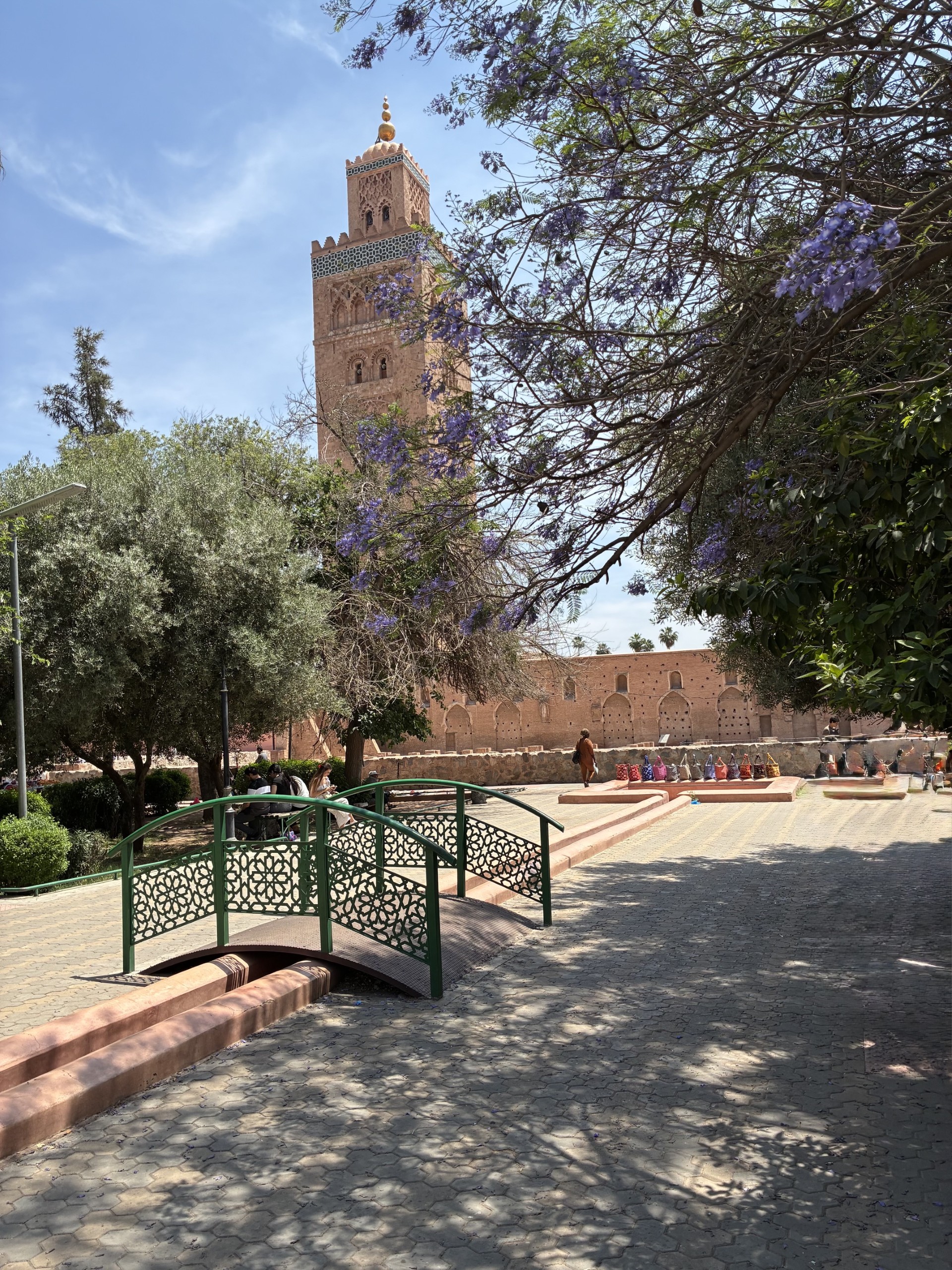
Non-Muslims aren’t allowed inside, but the exterior of this edifice, built in 1147, was quite impressive. While there, the adhan (call to prayer) occurred. We have heard these before during visits to Muslim countries, but this particular man’s voice was the most melodic ever! There was a nice little adjoining park with jacaranda trees in full purple bloom. Dinner was again at the hotel: Someone here could sure cook as we were served a fabulous black seafood pasta.
For the following day I had booked an all-day private tour to the Atlas Mountains through Morocco Inspiring Tours (moroccoinspiringtours.com) for $267. Our guide, Abdullah, arrived promptly at 8:10am and we were off. The first stop was a busy tourist attraction involving tea, honey, and Arabian sweets, all of which were for sale. We were served on a roof-top garden where unfortunately, bees swarmed the outdoor tables. I cornered Abdullah and insisted we leave. This was NOT what we had in mind: We wanted to see places without tourists and didn’t want any more shopping opportunities.
Fortunately, he took my concerns to heart and focused on scenic overlooks plus a stop at a pretty little riverside park. Here we were alone, except for the sweetest kitten, who immediately climbed up on Lynn’s lap and purred loudly. From there we accessed a gravel road that led into the countryside, a fertile area where orchards of apples, pears, and ancient olive trees abounded. It was beautiful country, and against the bluest of skies, the snow-tipped Atlas Mountains loomed. With the area prone to earthquakes, collapsed ruins were scattered amongst the dwellings in many villages.
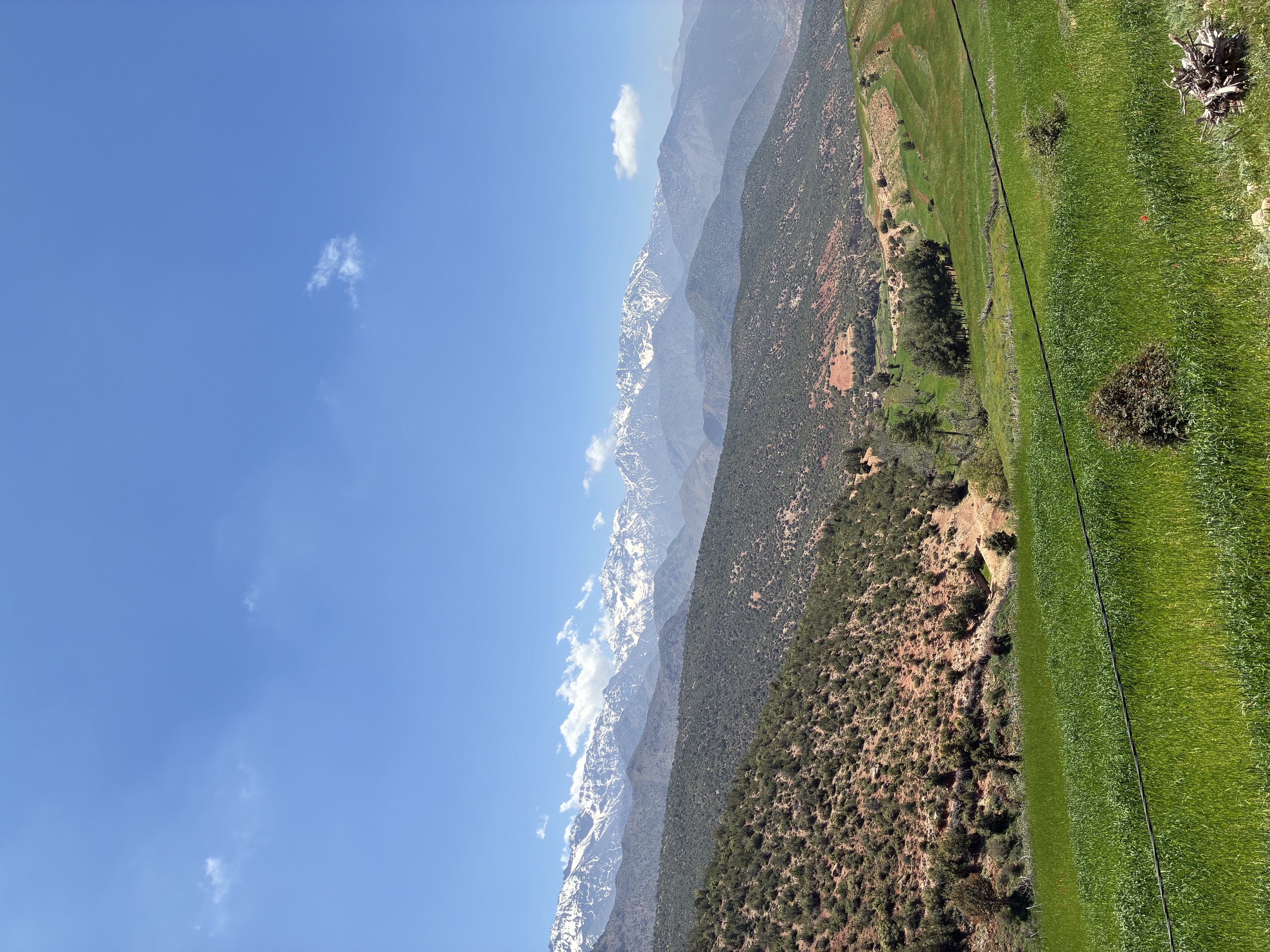
Eventually we stopped at one of the villages and were introduced to Abduh, a friendly local youth who would take the two of us on a mile hike before rejoining the van. Abduh confided that he had learned English from YouTube and told us the government provides free internet access to its citizens. He shared lots of information about rural life and local fauna. We briefly shared the gravel road with a flock of goats being guided to higher pastures by a shepherd and his dog.
We were served lunch in a Berber village on the back deck of a woman’s home with an incredible view of the valley and the mountains. She had prepared a feast featuring chicken tagine, roasted vegetables, squash soup, and spiced couscous. It was very tasty, and despite our best efforts, we could only eat a quarter of everything served.
Agafay Desert
The next morning, we checked out of La Maison Arabe as we would be spending the night at Oxygen Lodge (oxygenlodgeagafay.com) in the Agafay Desert. The price for lodging and meals was $370. The lodge had arranged a 10am taxi pickup for $30. Once we were out of the city, most traffic disappeared. Again, the Atlas Mountains spread against the horizon but this time we were approaching them from their leeward side. Now the mountains blocked access to the prevailing winds and rain, creating a more barren landscape than seen yesterday. Villages were scattered and desolate in appearance.
After less than an hour, we arrived at the entrance to the Agafay Desert, and the paved road became gravel and sand. This was another tourist area, with facilities renting off-road quad bikes and even several with camels, if that was your choice of transportation. Luckily, Oxygen Lodge was one of the more distant ones, with nary a tacky rental facility in sight.
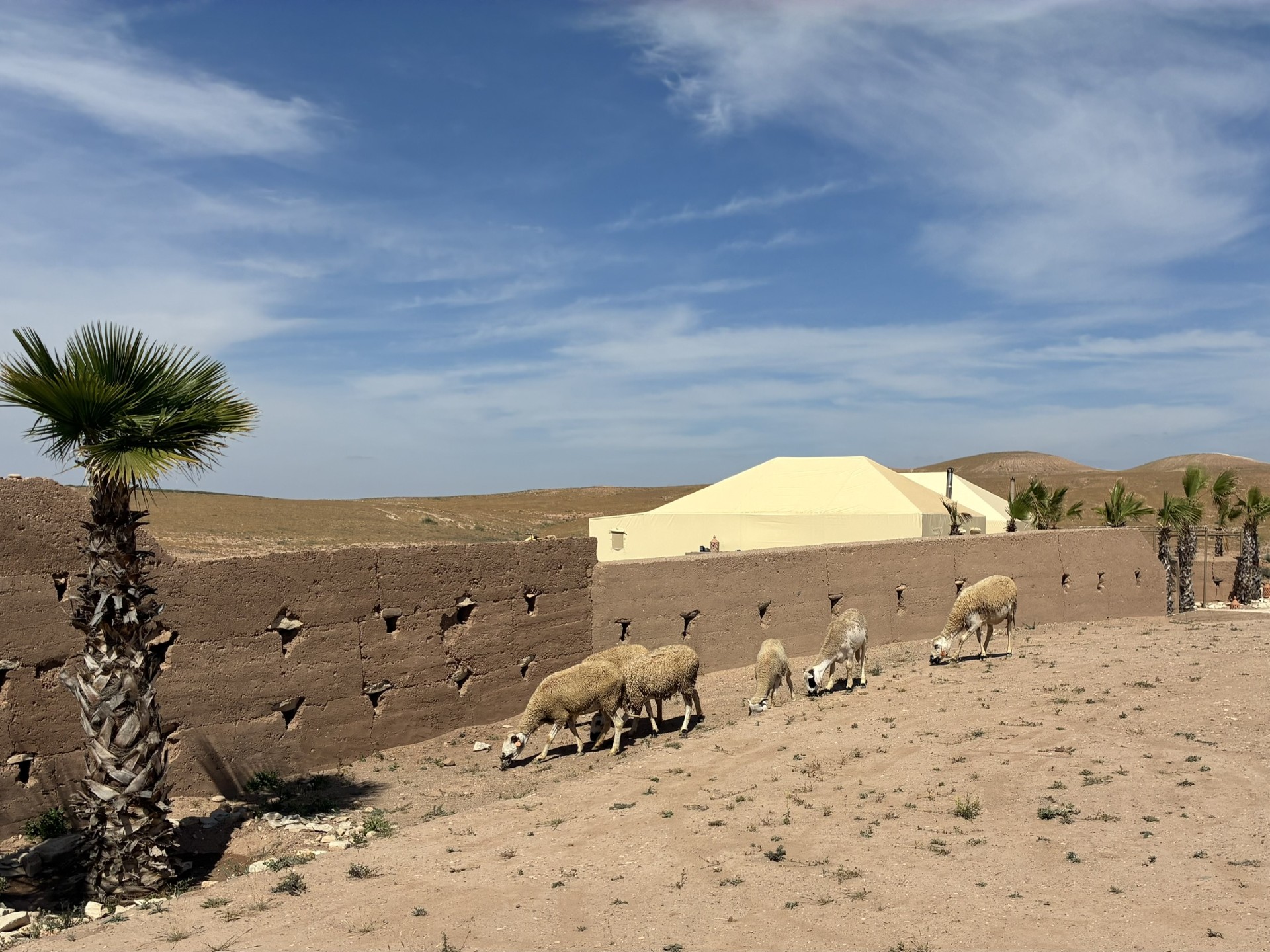
With rocky soil and sparse vegetation, the terrain was reminiscent of the American Southwest. However, April had been an unusually rainy month, so there were occasional splashes of green on the hillsides, along with a much-appreciated cool breeze. We were warmly greeted by the staff and served the usual hot tea before being led to our abode: an elevated spacious tent with a private bathroom, plus solar-powered air-conditioning and lighting. Glamping at its best!
Back in our tent after enjoying the large pool onsite, I was cleaning up when Lynn insisted, “You have to come see this!” Just outside a huge herd of very noisy sheep and goats were grazing on whatever vegetation they could find.
Eventually, a shepherd and his young son appeared, and with only some vocal clicking noises, rounded up the strays and headed them on their way.
That evening while walking to dinner, I spotted two locals with their camels in a nearby valley. Ok…This I had to see. Not sure if anyone spoke English, I pantomimed taking a photo of the camels.
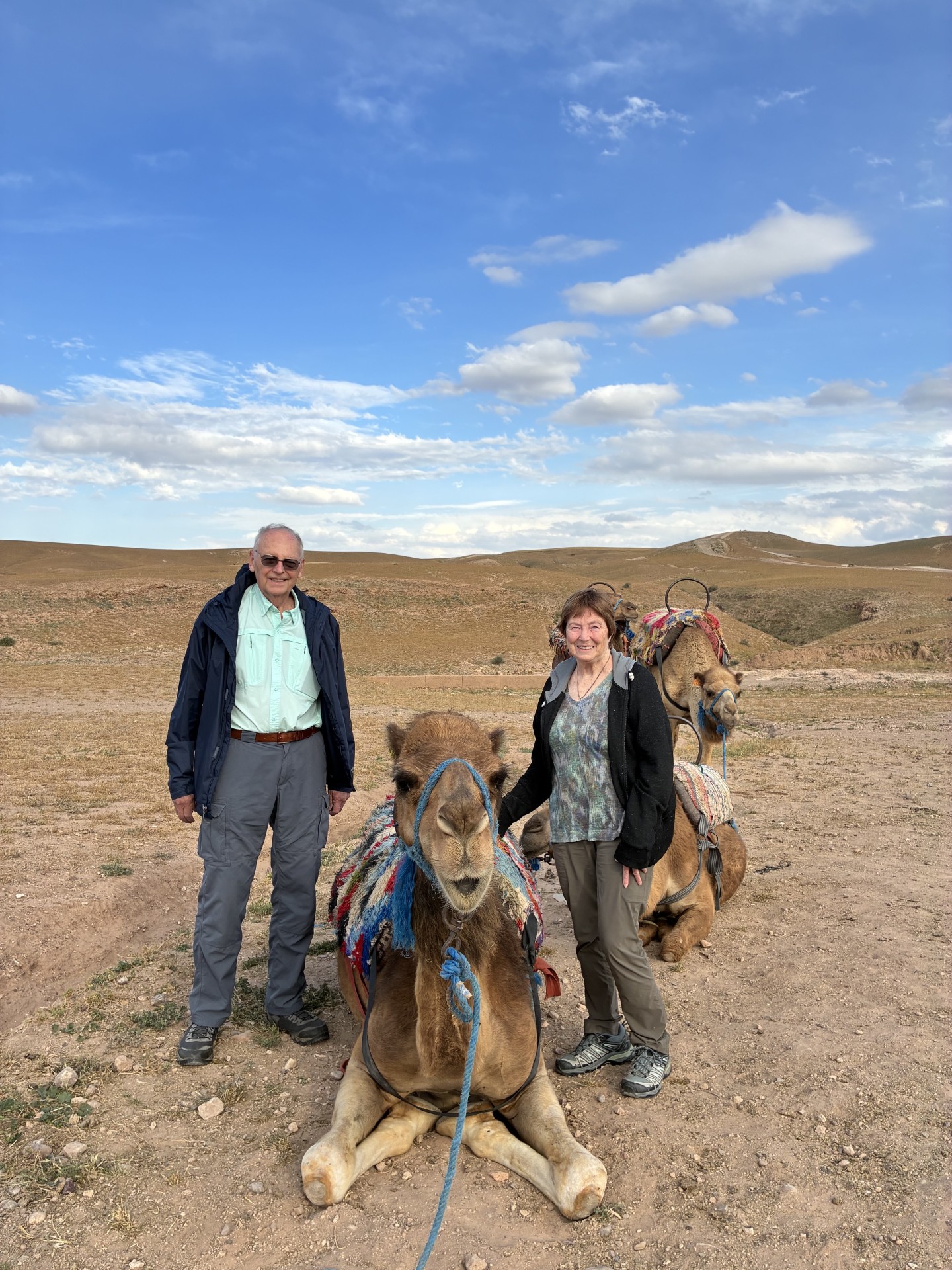
Since the men were so gracious about it, we handed over a €5 bill in appreciation. That prompted big smiles and an offer for us to pose with the animals while one of the guys took our photo. Even the camels appeared to be smiling.
Our dinner that night was enhanced by a three-man band featuring the drums and local stringed instruments of the nearby Berber tribes. Despite the presence of a large firepit, as dusk fell the wind became colder and we ultimately returned to our tent. Around midnight, I got up to check for stars, but there was too much moonlight.
Although it was chilly when we awoke, our in-room heater quickly warmed up the tent. At breakfast, the other guests seemed much younger than we senior citizens, including several families with children. When I asked our waiter if they had ever had folks our age stay here before, he thought for a minute before replying, “Once.”
Back in Marrakech
We would be returning to a different hotel, the Riad Kniza (riadkniza.com), $195/night back in Marrakech. Unfortunately, our taxi driver was clueless about its location until I found the place on my phone’s GPS. Now, he had a general idea of the location, but as taxis are not allowed inside the medina’s walls, the driver stopped at the gate and indicated we needed to continue on foot. “Where exactly do we go from here?” I asked. He replied with a shrug. “Then we are not getting out” I insisted. After a short impasse, the driver asked if I had the hotel’s number, phoned them, and soon a hotel employee appeared with a luggage cart. We tipped the driver generously for his trouble and ended our encounter on a friendly note.
Riad literally means “enclosed garden” and Riad Kniza was a much more traditional structure than La Maison Arabe. The owner, who once lived in the original dwelling, eventually purchased the adjoining ones and modified the structure into 19 guest rooms plus common areas. After serving us the traditional tea and cookies, a receptionist led us on a quick tour of the place, which included a small pool and a lovely rooftop garden.
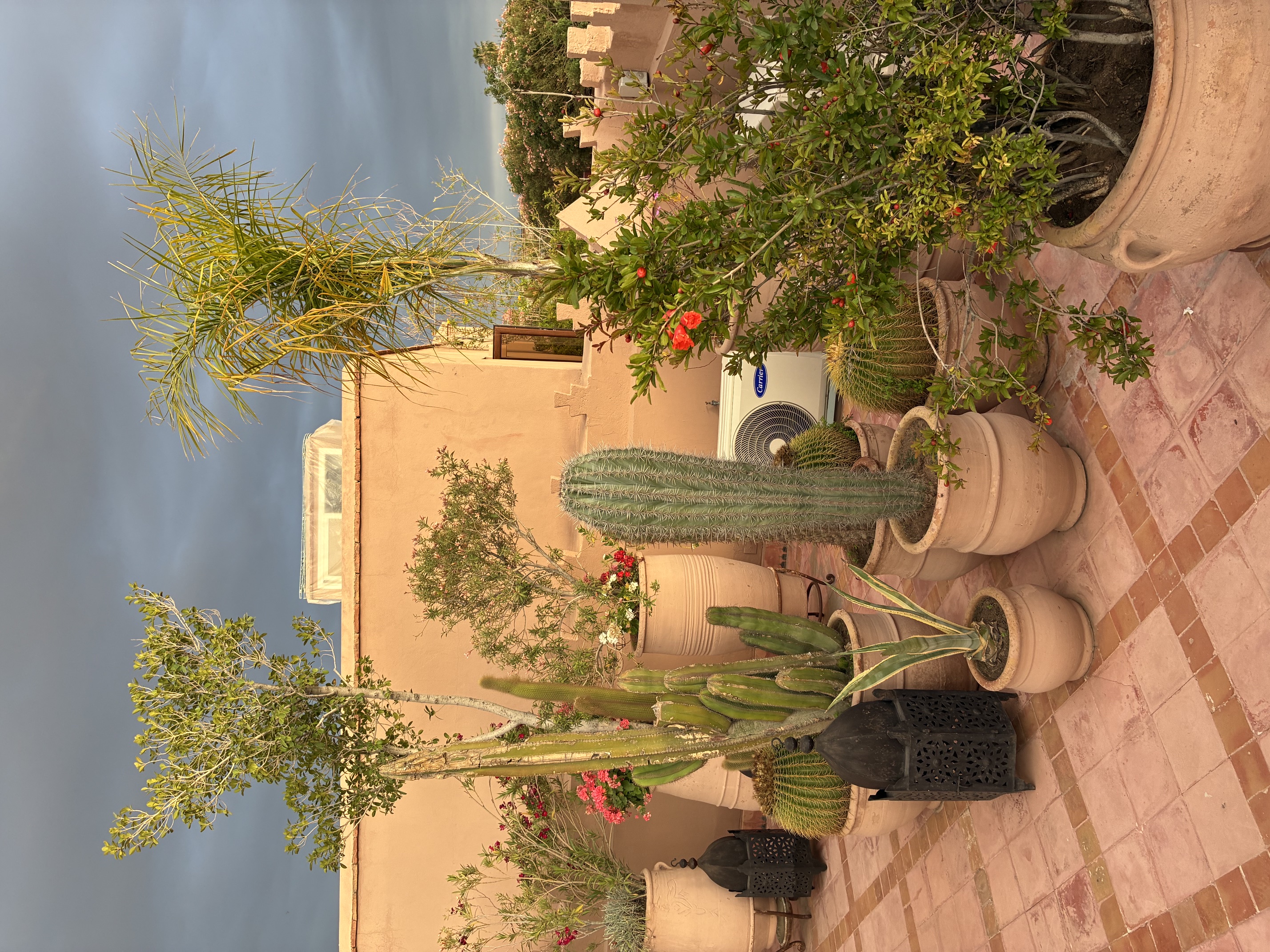
Apparently, the owner (Mohammed) was a very important and wealthy antiquities dealer and there was a whole photo wall of him with famous people. Even more exciting to us, we learned this man owned a private museum filled with his best treasures, all displayed in the next building. The receptionist confided that select guests and friends were given the opportunity to view them if Mohammed were present, but they never knew when he would show up. Our room was at the top of a steep, winding staircase, but thank goodness, the receptionist carried our bags up for us. Our room overlooked a courtyard garden, and everything was beautifully decorated in typical Arabic fashion, including a very ornate door. Having skipped lunch, by 6pm we were starving, only to learn the dining room didn’t open until seven. Fortunately, a kind waiter emerged and convinced the kitchen staff to feed us. Our fish tagine plus wine was very tasty and cost $55.
Since we were up early the next morning there was plenty of time to enjoy Riad’s free breakfast. I had a wish-list of historical attractions to see, but knew we’d never find them on our own. My request to the receptionist for a local guide resulted in an 11am booking with Ali, who picked us up at the hotel for a private, four-hour walking tour that cost €50. Ali was around 65 years old, dressed in traditional long robes, and spoke excellent English. After some discussion about an itinerary, he led us into the souks. Our first stop was the Dar El Bacha Museum (darbacha.com), a former governor’s palace from the early 20th century. There was quite a line at the entrance, but guides are allowed priority, so we zipped past everyone. The museum housed some amazing artifacts: Our favorites were ancient pottery, gorgeous rugs, and unique musical instruments. The building itself was lovely, with intricate woodwork, ornate tiled walls, and lavishly painted ceilings.
Our next stop was the Madrasa Ben Youssef (medersabenyoussef.ma), a former religious college founded in the14th-century and rebuilt in the 16th-century, that today is open to visitors. The attraction here is its ancient tilework, considered among the finest in the Muslim world. Beautifully tiled walls encircle a huge inner courtyard with a fountain and seating. There is even a workshop on site solely to repair any damaged tiles or woodwork. Quite the place and again, we could skip the line.
For our final adventure, since most of the souk’s vendors sold touristy items or food, I asked Ali if he could show us areas of the market where high-end wares were for sale. Sure enough, he then took us to some wonderful shops full of exquisite wooden boxes, gorgeous pottery (some inlaid with camel bone), leather goods, an art gallery, and fine metalwork. Even though I hate shopping, I found something I loved in each place. Unfortunately, we didn’t have the funds or the room in our carry-on bags to bring much home.
With the tour finished, Lynn and I were hanging around our hotel’s reception area and learned that the Riad’s owner would be in that evening. Here was our opportunity! We kept our room’s door open and our ears perked up. Around 5:30pm our vigilance was rewarded when I heard an older man’s voice down at the reception desk. Peeking around the staircase, I spotted him!
We waited for a break in the conversation, then introduced ourselves and raved about our stay. Lynn mentioned how much he appreciated all the antiques in the hotel, since that was a big passion of his. Mohammed beamed and graciously invited us to visit his personal museum. After unlocking the door to his treasures, he explained that although he had a pressing meeting scheduled soon, his teenage grandson would personally show us around. The next hour was one of the highlights of our trip: Mohammed’s treasures surpassed almost anything we had ever seen in a museum. Magnificent rugs, intricate gold jewelry, ancient furniture, fine textiles, and pottery were all beautifully displayed and explained by our very enthusiastic young guide.
Since Mohammed’s meeting had taken over the dining room, the staff served Lynn and me dinner in one of the smaller common rooms. Our meal included the best tagine we’d eaten in Morocco (lamb prepared with exotic fruits and nuts) and entertainment by a singer of Arabic music with haunting minor-chord melodies.
The next day started with a leisurely morning and nothing special on the agenda. However, I did have big afternoon plans: a 4pm appointment for high tea ($60 per person; reservations required) at the very elite Royal Mansour Hotel (royalmansour.com/en/marrakech).
Knowing it would be a fancy affair, Lynn and I showered and donned our best and cleanest shirts and pants, but sadly our scruffy tennis shoes detracted from the image.
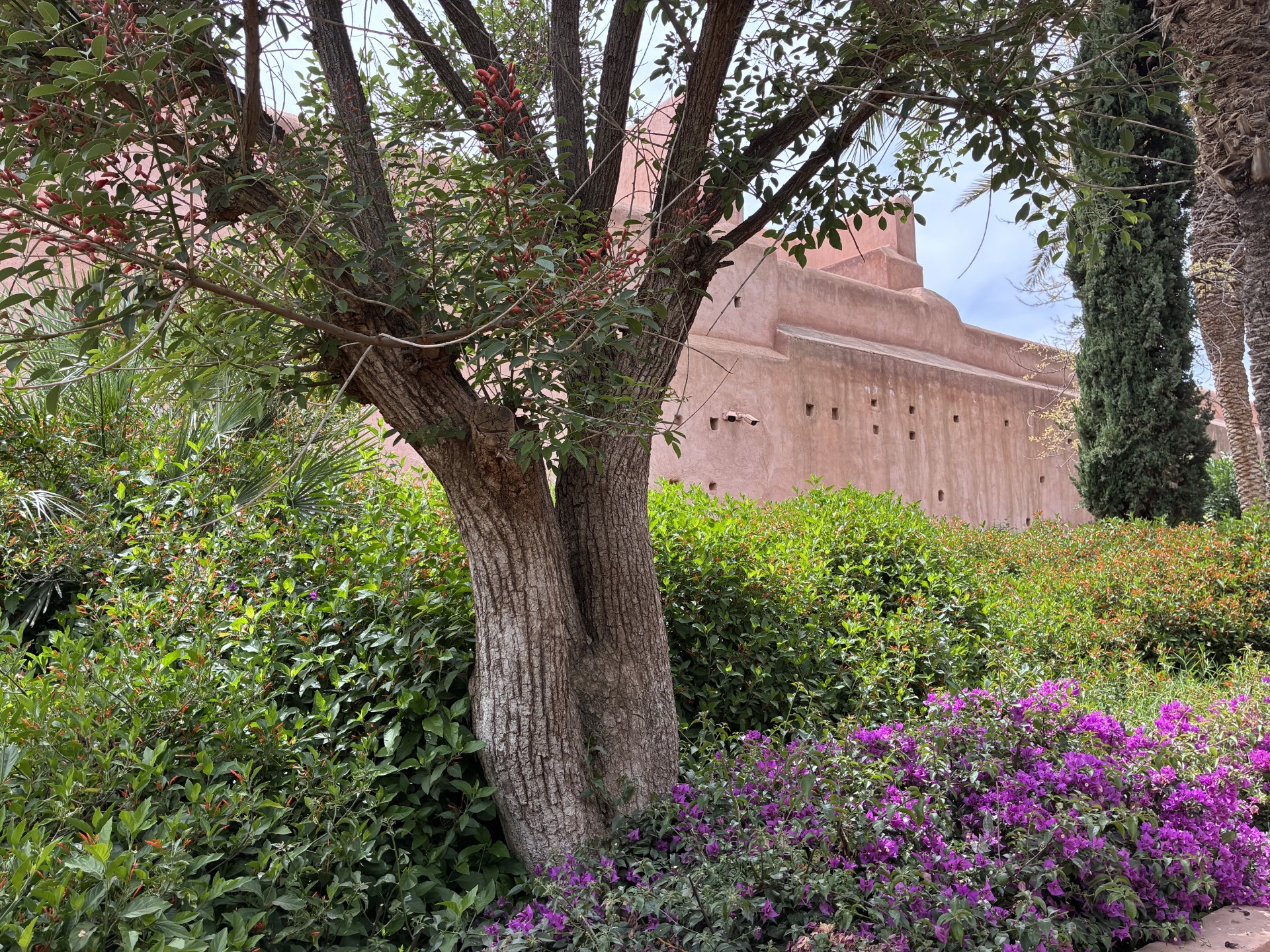
We decided to leave by 2:30pm, since guests attending the tea were also allowed to visit the hotel’s magnificent gardens. We headed out of the medina to find a taxi. Unfortunately, the one that stopped for us was probably the worst-looking taxi possible, with rusted fenders and belching smoke. Our arrival at the Royal Mansour provoked a stunned reaction from the gatekeepers. I piped up that we had tea reservations, but they looked suspicious and insisted our driver pop the trunk for inspection before waving us through. However, the hotel staff was warm and welcoming. “Of course, you are free to roam the grounds--just stay on the paths,” one said. What gorgeous landscaping! The paths wound past an impressive swimming pool, huge old trees, manicured lawns, flowering shrubs, garden benches, and more, all enclosed within the ancient walls of the medina.
At 4pm, Lynn and I presented ourselves to the maître d’ at the hotel’s outdoor tearoom. Since it was obvious we looked nothing like their regular guests (who were gorgeous, dressed impeccably and dripping in jewels and fancy watches) his first question was, “Where are you staying in Marrakech?” When I told him, he said that its owner was his “good friend.” My response, “You mean Mohammed? He is indeed a wonderful man and even showed us his incredible collection of antiquities.” The maître d’s amazed expression instantly morphed into one of warm camaraderie, and he proceeded to lead us to the best table. What followed was a long succession of delicacies served by a very attentive waiter. We couldn’t finish the final course of fancy cakes, which were then wrapped in an elegant take-out package for us.
For our return trip, the staff called a taxi…and a new Mercedes arrived. (Of course, he charged us three times the amount of our earlier rattle-trap cab, but by now we had an image to uphold.) Back at Riad Kniza, with an early departure to Lisbon the next day and not at all hungry, we gave our take-out goodies to the delighted staff and headed to bed. We would sure miss this country.
In sum, we found Marrakech and its surrounds to be fascinating. All of our lodgings were amazing with air-conditioning and exceptionally good food. The extensive medina is clean and filled with history. Locals are friendly, and many know at least a smattering of English.
Tips
Credit cards were accepted by all our lodgings and their restaurants as well as the tour company. When tipping staff or paying for our local guide, euros were welcome as well as local currency. As far as the latter, an ATM withdrawal of $100 gave us 940 dirhams while local taxi rides ranged from 30 to 100 dirhams.
We drank bottled water throughout our visit. While hesitant to eat any street-food in the market, food and drink everywhere else never gave us any problems at all.
Moroccan cuisine is famous for its tagines (a kind of stew), sweet desserts, and herbal teas, all of which are delicious. Alcoholic beverages are available in hotels and restaurants, but not in the souk.