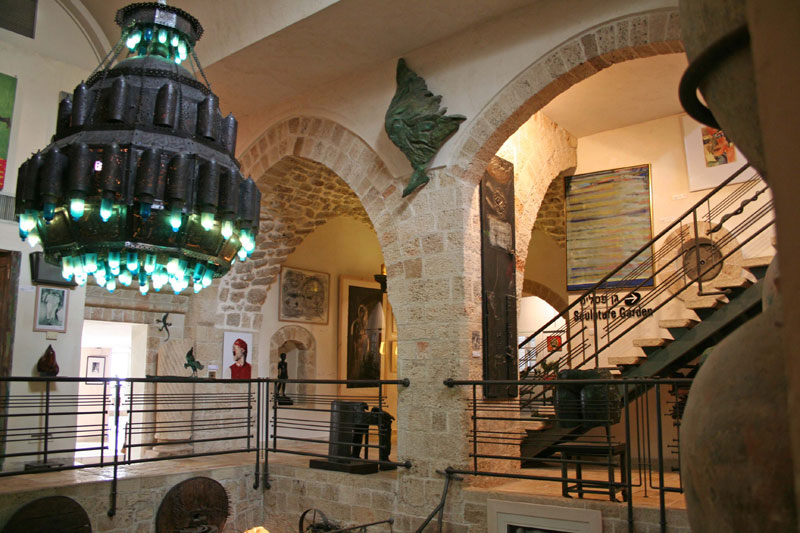
Ilana Goor in Jaffa

A good alternative to the more well-known museums in Paris is the Musée Carnavalet (23 rue Sévigné, 75003 Paris; phone 01 44 59 58 58).
The man who coined the word “dinosaur,” Sir Richard Owen, campaigned for a “national museum of natural wonders.” Two hundred years after his birth, this founder of the Natural History Museum is being celebrated in London with a special display and self-guided trail (through Oct. 24, 2004).
When visiting CHINA, Xi’an was one of the highlights on our tour. This is a very old city and it has much to offer. I was anticipating specifically the Terra Cotta Army, which is probably the biggest tourist attraction, but what a surprise it was to find in Xi’an such a wonderful museum as the Shaanxi History Museum.
In Cape Town, South Africa, the District Six Museum (25A Buitenkant St.; phone 461-8745) memorializes an important chapter in that country’s history — when an entire neighborhood was bulldozed at the height of apartheid. Being a civil rights activist, on my trip in March ’04 I was attracted to this museum.
Running until Sept. 19, 2004, in London’s riverside Greenwich, the exhibition “A Garden of Fans” displays floral motifs on fans from Europe and Asia from the 17th century onward. The Fan Museum, at 12 Crooms Hill, is open Tuesday to Saturday. £3.50 adults, £2.50 seniors. Phone 020 8305 1441 or visit www.fan-museum.org.
The world’s first major museum dedicated to the life of British statesman and wartime Prime Minister Sir Winston Churchill will open in London in February 2005. The museum’s completion will coincide with the 40th anniversary of his death and the 60th of the end of World War II.
Including items from the Imperial War Museum and the Churchill Archives Centre at Churchill College in Cambridge, the permanent attraction is to be housed in the Cabinet War Rooms, the top-secret underground headquarters where Churchill and his government operated during the war.
The model for many open-air museums across Europe, the Nederlands Openluchtmuseum (Schelmsweg 89, Postbus 649, NL-6800 AP Arnhem, Netherlands; phone +31 [0]26-3576111) is the original folk museum in the Netherlands and the biggest. (In 2012, open March 30-Oct. 28. €14.95 [$18] adult, 10.50 child. Parking, €4.50.)
You’ll need a minimum of four hours to enjoy and completely immerse yourself in over 200 years of Dutch culture.
Possibly as long as 40,000 to 60,000 years ago, Australia’s Aborigines arrived on that island continent from Southeast Asia via the islands of Indonesia. Eventually they occupied almost all parts of Australia, including southeastern Australia, where Sydney is now located. Known archaeological sites near Sydney date back at least 15,000 years. That’s four times older than the Egyptian pyramids, the oldest of which dates to about 2600 BC.
As far as I’m concerned, there are two IQs for travelers: those who queue and those who don’t. If you plan ahead, you can avoid nearly every line that tourists suffer through (except for security checks).
Many museums are free one day a month — a great deal for locals, but for visitors it’s generally worth paying the entrance fee on a different day to avoid the hordes on a museum’s free day. The Sistine Chapel feels more like the Sardine Chapel when it’s open and free on the last Sunday of the month.