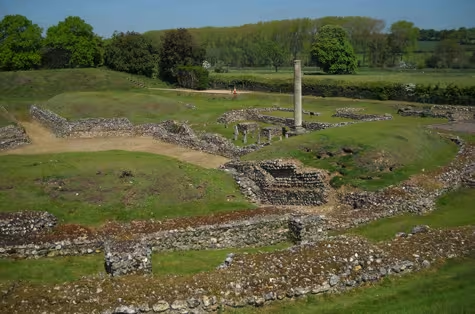
Fun day in St. Albans
Image
The oldest-extant surgical theater, located in the attic of an 18th-century church, can be visited in London. The newly refurbished Old Operating Theatre Museum (9a St. Thomas Street, London, England, SE1 9RY, U.K.; phone +44 020 7188 2679, oldoperatingtheatre.com) dates to 1822, when it became the surgery room for the St. Thomas Church Hospital.
Still present are the wooden bed where surgeries were performed (without the benefit of anesthetics or antibiotics) and the surrounding benches from which medical students watched.
Having grown up in Switzerland, I’ve been to Paris many times over the last 50 years or so, from before the heady days of the student revolts (1968!). There are a number of museums in the city that I seldom see listed in people’s reports but which I’ve found to be worth visiting, so I wanted to tell ITN readers about them.
To begin with, La Mairie de Paris (the mayor’s city administration) maintains 14 museums, many of which seem to be virtually unknown to overseas visitors. From that list, here are three favorites of mine where admission is free.
You can learn about more than 400 years of English gardening by visiting London’s Garden Museum (Lambeth Palace Rd., London, SE1 7LB, U.K.; phone +44 20 7401 8865, www.gardenmuseum.org.uk).
At the Museum of Miniatures (Strahovske navdori 11, Prague 1, Czechia; phone +420 233 352 371, www.muzeum miniatur.cz/en), the exhibits all must be viewed with microscopes.
Using self-made tools, artists have created miniature sculptures so small, each can fit in the eye of a needle or even on the leg of a mosquito. Highlights — a flea with golden horseshoes, a portrait of author Anton Chekhov on a poppy seed and the Lord’s Prayer written on a human hair. Open daily, 9 a.m.-5 p.m. Entry, CZK150 (near $6.40).
When visiting Japan’s Saitama Prefecture, fans of pareidolia can visit the Chinsekikan, or Rare Stone Museum (392-1872, Saitama Prefecture Chichibu City, Kagamori 764-5, Japan; phone +81 494 24 7288), where more than 1,700 stones that resemble human faces are on display. The collection, amassed over 50 years by the founder and still growing, includes rocks that have been described as looking like Elvis and Boris Yeltsin.
Open 10 a.m.-5 p.m. Wed.-Mon., but call ahead to be sure it will be open. ¥400 (near $3.60).
Music from one of 25,000 original music rolls played on any of several antique player pianos can be experienced in the Pianola Museum (Westerstraat 106, 1015 MN, Amsterdam, Netherlands; phone +31 20 627 9624, www.pianola.nl/Pianola_ Museum/Welcome.html). Visitors also will learn about the history and mechanics of player pianos.
The museum is open for general admission 2-5 p.m. on Sundays only. €5 (near $5.50). Private visits can be arranged.
Potsdam’s new modern art museum, Museum Barberini (Alter Markt, Humboldtstraße 5-6, 144467 Potsdam, Germany; phone +49 331 236014, museum-barberini.com/en), opened on Jan. 23. Housed in the rebuilt, 18th-century Barberini Palace, it has 17 galleries, including temporary exhibitions, with a permanent collection emphasizing East German art and art post-1989.
What’s new in Germany, Spain and Portugal
There’s plenty going on in GERMANY in 2017.
• The big news is the 500th anniversary of the Protestant Reformation. The Reformation began in 1517 when Martin Luther, a priest and professor of theology, wrote and published his 95 theses, questioning the corrupt ways of the Catholic Church. Throughout Germany, visitors will find events and exhibits honoring this anniversary, highlighted by three special exhibitions running from April until November in three different cities.