Notification with specifics
The reader’s letter “Unusual Transactions” (Feb. ’04, pg. 41) brought to mind some of our experiences with credit card companies and our prevacation routine.
04
The reader’s letter “Unusual Transactions” (Feb. ’04, pg. 41) brought to mind some of our experiences with credit card companies and our prevacation routine.
A letter in the November ’03 issue, page 38, stated that MBNA does not charge for foreign currency conversion. That’s true. What it doesn’t say is that the various credit card companies themselves are the ones that charge; e.g., Visa, 2%; AmEx, 2%, and MasterCard, 1%. I learned the above researching the veracity of the MBNA deal.
There can be significant ATM charges from the issuer, not the credit card company. In the case of the MBNA cards, the MasterCard holder is charged by MBNA 3% for ATM withdrawals. I’d sure like to know what the AmEx and Visa ATM charges are.
In the February’04 issue, two authors refer to the “rows of crosses” they observed at American military cemeteries abroad (pages 22 and 104). I have not been to Omaha Beach but did visit the American War Memorial outside of Manila and noticed that there were numerous symbols of faiths of soldiers of other religions who were killed on these battlefields as well.
BERNARD ZAZULA
New Fairfield, CT
I want to respond to the news item “Fighting Rebels in Nepal” (Feb. ’04, pg. 18).
In September ’03 my wife and I took a train from Berlin Ost Bahnhof to Prague, a 5-hour trip.
My husband and I have done quite a bit of traveling. We research in depth the places to which we are going. We do not like traveling with large groups, as we travel for art, history and architecture and do not want to be rushed through places where we would like to spend a lot of time. Thus, we travel alone or with a private guide.
Clutching our tickets, passports and visas (at — gasp! — $100 each), my husband and I inched into the Aeroflot line. It was Sept. 5, ’03, and we were bound for Moscow from San Francisco.
In 1934, Queen Mary of England christened the ship that bore her name. This 81,000-ton ship was the biggest and fastest ship of its day and celebrated its maiden voyage in May 1936. The jewel of Cunard’s merchant fleet and the quintessence of grandeur, it represented the finest in ship travel.
There she was, in all of her advertised superlatives: the greatest, the largest (151,000 tons), the costliest (about $800 million), the most beautiful superliner ever built, ad infinitum. It seemed that not enough praise could be lavished on any one vessel. In our opinion, she deserved all these accolades and more.
My wife, Lili, and I had seen news stories and ads in various travel papers and in our wildest dreams believed that being part of history in the Queen Mary 2’s maiden voyage might top off our life of travel throughout a great deal of the world.
by Russ Ellis, ITN
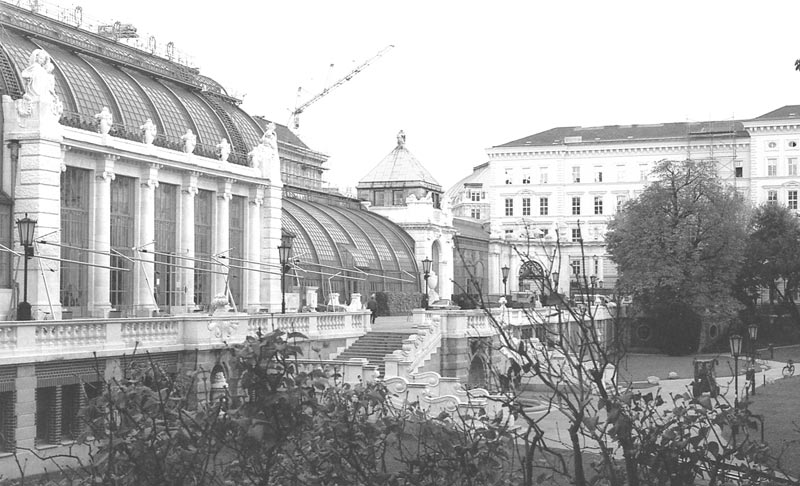
In October ’02, I was a guest on a 4-night tour of Vienna jointly hosted by Austrian Airlines and the Vienna Tourist Board.