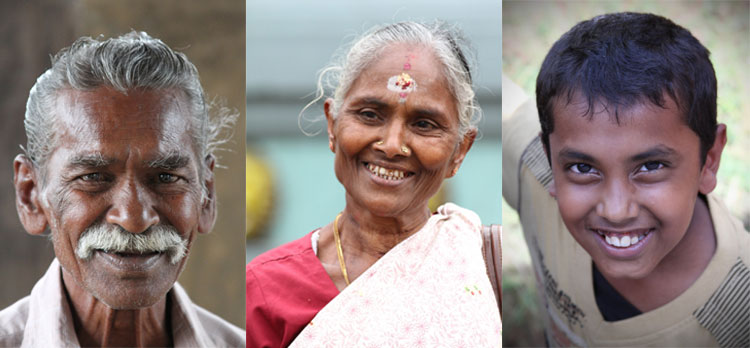
by Donna Judd; Fullerton, CA
The brochure sounded enticing — “Mysterious and exotic Sri Lanka awaits you!” — but since the government’s long battle with the Tamil Tiger rebels had ended only in 2009, I wondered if it was safe to travel in the former Ceylon.
A Burmese friend who works in Sri Lanka reassured me, e-mailing, “There are (sic) no more fighting going on in Sri Lanka, and it is safe to travel to almost every tourist place. Mines are mostly in non-tourist sites such as the Northern Province.”
So I decided to join 19 other adventurous photographers (several of them enthusiastic ITN subscribers), led by noted travel and wildlife photographer Michele Burgess, on the “Splendid Sri Lanka” tour ($5,390 from Los Angeles), Feb. 2-21, 2012, offered by In Focus with Michele Burgess (Huntington Beach, CA; 714/536-6104).
An interesting introduction
I had previously traveled with Michele to Namibia, and I love the sense of fellowship that develops almost immediately in her well-traveled, photo-oriented groups.
Our guide, driver and young “helper” provided by the local operator, Walkers Tours, were uniformly outstanding. In fact, I was not the only one who thought Rohana Bodhinarayana was the absolute best guide any of us had ever had.

Sri Lanka is fascinatingly diverse. Inhabitants are primarily Buddhist Sinhalese, with about 15% being Hindu Tamils. Sprinkled among them are descendants of Portuguese, Dutch and British colonizers.
Many of the signs are in the three main languages of the country: Sinhalese, Tamil and English. Enough English is spoken to enable visitors to get around easily. (Sri Lanka’s literacy rate is an impressive 94%.)
The people I met were warm and friendly, and I found myself getting the most pleasure out of just observing scenes of everyday life and interacting with people.
We visited colorful fish markets or fishing fleets in Hambantota, Kumarakanda and Negombo. In Negombo, one of the country’s largest fishing ports, we saw hundreds of fishermen using the old-style wooden catamarans — a striking sight.
At one beach, as we stopped to photograph a half dozen fishermen struggling to pull in a heavy, mile-long net, three of our group members put down their cameras, waded into the shallow water and joined ranks with the grinning fishermen, first in pulling on the rope, then joining in the chanting as well.
Capturing the sights
We took photographs at a Christian cemetery on the beach, a Hindu temple hosting a bejeweled wedding, and several mosques. There was always something interesting to see.
I had been looking forward to photographing the stilt fishermen at Weligama since I saw them gracing the cover of my Lonely Planet “Sri Lanka” guidebook, but this entire way of life, centuries old, was gone, reduced to a quick “photo stop.”

Where there had once been hundreds, there were now only two lonely, empty stilts. Two men rushed over as our bus stopped, arranged for payment, grabbed their fishing poles and quickly posed on the stilts for us.
Rohana said that most of the fishermen and their families had been swept away in the massive Dec. 26, 2004, tsunami that devastated the southern and western coasts of Sri Lanka. The huge waves killed between 30,000 and 50,000 Sri Lankans, sadly including Rohana’s brother and several friends. (The country’s economy has shown significant recovery since the tragedy, with an annual growth rate of 5%.)
After time in the hot, humid coastal area, we loved the hill country, with its cool temperatures, numerous waterfalls and green tea plantations covering the mountainsides. Based in Nuwara Eliya at the Grand Hotel, originally built in the 1820s by a British governor, we ventured out to tour the Labookelie Tea Estate. There, we drank the best tea I’ve ever had, then photographed tea pluckers and stood below beautiful St. Clair and Ramboda waterfalls.
Sri Lanka is one of the world’s largest tea exporters, but the industry exists on the backs of the Tamil women, who make only $5 a day picking tea.
The wildlife
During my visit, I learned that about 20% of Sri Lanka is national park land or animal sanctuary. I had no idea wildlife was so prevalent there.
Yala National Park is one of the best places in the world to see leopards. We saw them on our morning and afternoon game drives, as well as Asian elephants, a sloth bear, deer, wild boar, crocodiles and water buffalo. Nearby Bundala National Park offered up more animals, including a cobra and python, plus many of the nearly 200 bird species it harbors.
My favorite wildlife experience was watching a gorgeous peacock flaring his feathers, preening and strutting around for a good 10 minutes while his lady friend kept pecking the ground for food, totally ignoring the showoff. Another pleasure was holding a tiny, 2-day-old turtle in my hand while learning about the turtle rescue program at Kosgoda Turtle Centre.
In Sri Lanka, wildlife is not just for viewing in a park; it is still part of everyday life.
In rural areas, we sometimes passed fields with tree houses 20 feet in the air. As crops ripen, farmers are forced to spend nights there, throwing firecrackers to keep marauding elephants from destroying their crops.

Elephants also sometimes appear just inside the electric fencing separating one end of Uda Walawe National Park from the road. Locals buy bunches of 20 to 30 bananas and throw them over the fence to the elephants, as our guide demonstrated for us. Apparently, they just enjoy the interaction with the animals.
We also saw elephants at Hindu temples and, once, one just sauntering down the road, a truck waiting to pass it.
At 7:30 one morning I woke to what sounded like bombs being dropped on the tin roof of my bungalow at Chaaya Wild Yala hotel. Actually, it was three extremely large monkeys jumping from the trees onto my roof. I also saw monkeys on telephone lines, in temples and alongside the roads.
A few favorites
Several of the scheduled “touristy” activities were especially enjoyable, including a cultural show of dancing, drumming and fire walking in Kandy. Yes, the two fire walkers walked mainly on their heavily callused heels, but, still, they were barefooted and those coals were hot — so hot that I felt the heat from my second-row seat!
Another touristy pleasure was buying a mask, one of Sri Lanka’s most popular collectors’ items, at Nishantha, where we saw woodcarving demonstrations.
A visit to the Pinnawala Elephant Orphanage was a highlight of the tour. We watched dozens of elephants enjoying the river, trumpeting, playing and cooling off before the
4 p.m. feeding time necessitated their being herded back to the orphanage.
An aging, blind bull and an elephant that had lost a foot to a land mine were among the 85 Asian elephants being cared for. Babies are fed five times a day, providing plenty of opportunities to see feedings.
My favorite meal was one of delicious native foods prepared by a farmer’s family at Dewa Tourist Village. We sat in an outdoor pavilion overlooking his green, green rice fields and, using our fingers and chapatti, scooped up breaded fish balls, curried rice and a combination of shaved coconut, rice flour, spices and chilies.
Our food — whether hotel or restaurant, buffet or à la carte — was quite good, even though, as someone allergic to fish, disliking curry and unable to handle spicy foods, I missed out on many of the Sri Lankan dishes others enjoyed.

I did try, and liked, “hoppers” (aappa), the country’s traditional snack mentioned by every native author I’d read. A combination of rice flour and coconut milk often made like a crêpe, it is rolled up and eaten as a snack or served with eggs for breakfast. It can also be shredded thin, like spaghetti; this “string hopper” is served at lunch or dinner with various sauces.
My favorites of Sri Lanka’s UNESCO World Heritage Sites were Fort Galle and the Temple of the Sacred Tooth Relic.
Fort Galle, built around 1663, is one of the largest of the forts built by the Dutch. It was not just ruins but was “alive” with 400 shops, homes, excellent museums, restaurants, colonial buildings and old churches and mosques — even locals playing cricket on the grass of the upper walls in the late-afternoon sun.
Similarly, at the Temple of the Sacred Tooth Relic in Kandy, I enjoyed people-watching — vendors selling flowers to be presented inside the temple; devotees in white robes on pilgrimage from Japan; people renting slots to store their shoes; little children laughing at the monkeys’ antics, and large groups at prayer — made all the better since we were there during the full-moon holiday.
The temple is revered by Buddhists because it holds a tooth of the Buddha. Unfortunately, you can’t see it. In fact, due to the crowds, you’ll probably just get a glimpse of the gold casket surrounding it, displayed only during the daily prayer periods.
Historic sites such as Anuradhapura, the ruins of a great city that became a capital in 380 BC, helped us realize how early civilizations developed in Sri Lanka.
At another World Heritage Site, Dambulla, the Royal Rock Temple is world famous for its spectacular, Buddha-filled interior. I could not handle the 242 steps up to the caves, but friends came back with striking photos.
With so much to see and do in Sri Lanka, I returned home with much to share. After talking to my daughter’s kindergarten students, I asked what they remembered about what I had told them about Sri Lanka. My favorite reply was, “It’s a teardrop that slid off the cheek of India.”
Marco Polo judged that teardrop to be “better than any other island in the world.” Why not find out for yourself?
Similar articles
-
 April 2022
Seychelles — enjoying a tropical island escape
-
 January 2022
Rick Steves’ Europe: London: Beach-combing through history
-
 October 2021
Wonderful winter wildlife in Japan
-
 March 2021
Connecting without words
-
 June 2013
Capturing the exotic charms of Sri Lanka on a photo tour
-
 November 2012
What's Cooking in... Myanmar