
by Bill Altaffer, San Diego, CA
In the last week of August 2011, eight of us met our excellent tour manager, Paul Schwartz of MIR Corporation, in Baku, the capital of Azerbaijan, for a custom trip that would begin in the Caucasus Mountains and end in Greece, covering a widely diverse group of countries and experiences.
Beginning in Baku
The Caucasus is an excellent location for studying man’s early development as well as for witnessing the longstanding cohabitation of peoples of Muslim and Christian faiths. Present-day Azerbaijan, a former Soviet republic on the west bank of the Caspian Sea, has done an excellent job of overcoming its former dusty, desert image. It is a Muslim nation on the relaxed, casual side.
I had visited Baku 15 years before, and I was amazed at the dramatic changes it had undergone in such a short time, primarily as a result of the country’s oil wealth. These changes were immediately apparent in the multitude of ultramodern buildings lining the new road from the airport, ongoing construction everywhere in the city and the preponderance of expensive automobiles on the streets.
For accommodations, there are now many multistar hotels to choose from. Across the busy 6-lane street from our hotel, a slick, high-end shopping mall blocked our view of the Caspian Sea and marked the beginning of a wide, landscaped park that fronted the sea for a good mile.
Baku is a busy port, with ferries departing frequently for Iran, Turkmenistan and Kazakhstan. These trips take about 24 hours.
Venturing a couple of hours from the city, we visited Gobustan, a complex of prehistoric caves with thousands of well-preserved ancient petrogylphs. This was our first UNESCO World Heritage Site of the trip.
On returning to Baku, we visited its Old Town (Icheri Sheher) inside 12th-century walls and toured the Shirvanshah’s Palace complex, our second UNESCO site.
At the Azerbaijan Carpet Museum, we admired displays of Caucasian and Iranian carpets, with their vivid colors and bold designs.
The following day, we flew for over an hour to Nakhchivan Autonomous Republic, an exclave of Azerbaijan, for the day. Nakhchivan means “place where they descended,” and it is believed by locals to be the spot where Noah settled after his descent from nearby Mount Ararat.
We were taken to a newly restored site claiming to be the tomb of Noah, followed by a visit to a very interesting abandoned salt mine now used as a health spa. We walked half a mile into the mine, where the main tunnel branched out into a number of very large rooms full of beds. No one occupies the rooms during the day, but we were told that, at night, many of the hundred-plus beds are used by people wanting to breathe the salty air as therapy for respiratory issues.
On to Georgia
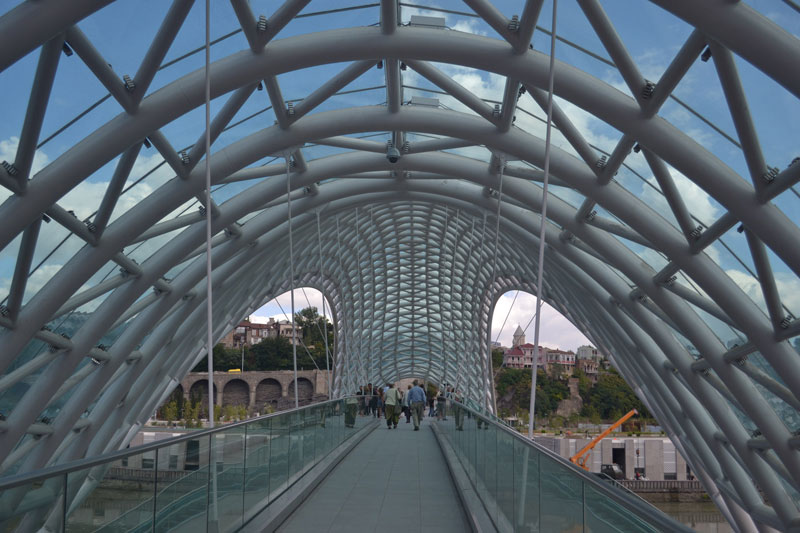
Back in Baku, we continued by air to Tbilisi, the capital of Georgia. Founded in the fifth century, the city is nestled in green hills on the banks of the Kura River, which starts in Turkey and enters the Caspian from Azerbaijan.

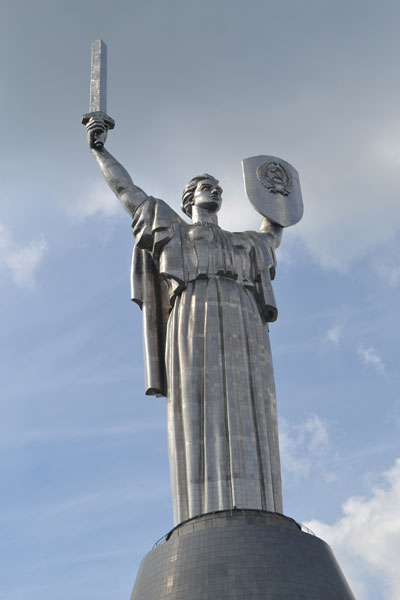
On the highest hill, a large “Mother Georgia” statue surveys the city. In one hand she wields a sword for her enemies, and in the other she holds a bowl of wine for her friends.
Historically, Tbilisi has been home to peoples of diverse cultural, ethnic and religious backgrounds. It is a charming city with beautiful old architecture — a mix of medieval, classical and Soviet structures — as well as outdoor cafés and lots of atmosphere.
One interesting aspect of the city is that it does not “get going” until stores start opening at 11 a.m. and does not “shut down” until late at night.
We stayed at the Marriott Hotel, which was very elegant and well appointed. The breakfast buffet was so nice that photography was prohibited.
Tbilisi is one of few places in the world where you can find a synagogue and a mosque next to each other, but, like the rest of Georgia, the city is predominantly Christian. The country is full of old Christian churches and ancient monasteries, many of which are UNESCO sites. We visited two of these on excursions from the city.
Next we drove to Gori, the birthplace and hometown of Joseph Stalin, where we toured a modest but interesting museum. Its grounds feature the humble house he was raised in (two small rooms) as well as his private train car. These are kept locked, but a museum curator opened them for us to enter.
Our excellent local guide described growing up in Soviet times. She thought her family was vegetarian, only to learn later that they had not eaten meat because they could not afford it. Now, it is a different story.
The people of both Georgia and Armenia (the next country we would visit) are very proud of their history and culture as well as their high-quality fruits and vegetables. Even the springwater of both countries is naturally pure; the springwater of Georgia is world famous.
Georgia was the one country visited on this trip that our group most wished we could have stayed in longer.
Armenia
We drove a few hours on mountain roads, winding through green forests, to the border of Armenia, where we met our next local guide (also excellent). The border crossing was easy.
We spent two nights in Yerevan, the capital of Armenia. The city is a lively mix of the modern and the very old. Looming over it is Mount Ararat, its ice-covered peaks creating a dramatic backdrop for the bustling city.
A highlight of our stay in Yerevan was a visit to the Matenadaran, an archive which holds thousands of ancient manuscripts, book fragments, ancient records and documents in a number of languages. Its main point of interest is a collection of miniatures and rare, ancient book bindings, many of them restored.
The room where these are displayed is small, with only a few choice items out to be viewed by the public. The oldest items on display are about a thousand years old, with many others dating back 600 to 800 years. They were fascinating to see.
The beautiful illuminated books, with their tiny, intricate drawings in brilliant colors and gold leaf, were truly amazing.
Another “must see” in Yerevan is the Genocide Memorial, located on top of a hill overlooking the city. It commemorates the million-and-a-half Armenians who were slaughtered by the Ottoman Turks between 1915 and 1923. The memorial tells the story of this genocide, little known elsewhere in the world, in a truly moving fashion that left our group very subdued.
In contrast, we had fun visiting the Yerevan Brandy Factory, where we enjoyed a tasting after our tour. Yerevan is famous for its brandy. Churchill allegedly ordered 400 bottles of it a year from this factory.
The historical clash of Christian versus Muslim was obvious when we drove to the enclave of Nagorno-Karabakh, a mountainous, Swiss-like part of Armenia and the stage of a war nearly 20 years ago between Armenia and Azerbaijan which resulted in the displacement of many people from both sides. As yet, there has been no formal ending to this war, and ownership of this territory remains in dispute. Though it is part of Armenia, there is a border crossing into Nagorno-Karabakh, where less than $10 buys a colorful visa allowing entry.
We spent two nights in Stepanakert, a friendly, village-like city that was formerly a prime holiday destination for top Soviet officials. This Soviet influence remains apparent today.
We returned to Yerevan for one night before leaving the Caucasus region and the Asian continent.
Belarus
An early flight took us from Yerevan to Minsk, the capital of Belarus.
It was immediately apparent that we had arrived in Europe, judging by the architecture and scenery viewed from our bus as we drove to our hotel.
Like all the countries on this trip, except Greece, Belarus was celebrating 20 years of independence in 2011. However, when the Soviet Union broke up in 1991, Belarus did not want to be separated from Russia, but the country was not given a choice. The government is a democracy in name but is really a dictatorship with strong ties to Russia. Everyone speaks Russian, signage is in Russian and much of the food has a Russian influence.
About 30 miles outside of the city is something truly moving that left me speechless: the Khatyn Memorial Complex. Contrary to most war monuments, this is not a tribute to soldiers but a memorial to the civilians who were slaughtered during WWII. I have visited every country in the world, and no other place has moved me as emotionally as this memorial did.
The complex is located where the small village of Khatyn stood before it was completely destroyed.
On March 22, 1943, a German convoy was attacked by partisan guerillas six miles from Khatyn. Four military police officers of the 118th Schutzmannschaft Batallion were killed, including 1936 Olympic champion Hauptmann Hans Woellke.
In retaliation, the battalion, reinforced by a unit formed for anti-partisan tasks and composed mostly of criminals, drove the villagers from their houses into a barn. The barn was covered with straw and set on fire. When the trapped villagers broke out through the front door, they were cut down by machine-gun fire as they tried to escape.
One-hundred-forty-nine people, 75 of them children, died. The village was then looted and burned to the ground. Four children survived, two by escaping into the woods and two because they had been shielded from the fire by the dead bodies of their parents.

As we approached the memorial from the parking lot, our view was dominated by a large bronze statue of a man, the sole adult survivor of the village, carrying the dead body of his son across his outstretched arms.
On the spot where the barn had stood, there is now a symbolic barn, a concrete structure formed in the shape of a barn roof. All the 26 houses of the village had also been destroyed, and on each spot where a house once stood, concrete forms outline the area that the house had covered. Each of these has a concrete chimney with a plaque listing the names of the people who had lived there.
The narrow dirt road that used to go through the village is laid out now in concrete, with a symbolic open gate at each house to show the traditional hospitality of the Belarusian people. Bells chime every thirty seconds from the chimneys to commemorate the rate at which Belarusian lives were lost during the war.
In addition to Khatyn, 185 other villages in Belarus were completely destroyed and not rebuilt. At this memorial, each of these villages has its own symbolic headstone engraved with the details of that village plus a grave containing actual ashes from that village.
Alongside this cemetery, a long wall lists all of the many concentration camps that were in Belarus and the number of people who died in each one, totaling hundreds of thousands in all. The details of these deaths are horrific and were impossible to wrap my mind around.
It is estimated that 2,230,000 Belarusians died in the war. Knowing that Belarus is about the size of Kansas makes this figure all the more dramatic.
The Khatyn Memorial is a truly moving tribute to all of those innocent civilians. Its hallowed ground depicts to the world the price of war and hate.
Ukraine
We flew to Kiev, Ukraine, for the last country on our itinerary. Kiev is another beautiful, old city full of magnificent Orthodox churches, classical architecture and whimsical statues. There we visited the Pecherska Lavra Caves Monastery Complex.
Founded in 1051, the caves and underground labyrinths were dug by the monks who lived and studied there. Now its many narrow passageways are lined with niches containing glass-topped coffins holding the mummified remains of monks from Mt. Athos, Greece.
We also visited the Chernobyl Museum. Chernobyl is in Ukraine, close to the border with Belarus, and those two countries received the brunt of the radiation fallout from the Chernobyl disaster. They are still suffering its consequences.
We had an excellent guide there who spoke English very well and gave us a fascinating tour of the museum. It was well worth visiting.
Yalta
After a short flight, we arrived in Simferopol, Ukraine. Our drive through the beautiful countryside of the Crimean Peninsula took us to Yalta. Situated on the Black Sea and tucked into a bay with mountains behind it, it is a lovely, bustling, vibrant and very cosmopolitan city.
The annual Crimea Music Fest was being held on the mile-long pedestrian promenade that goes along the coast, located directly across from our hotel, and we enjoyed the sights and sounds of the promenade. It had carnival rides, numerous classy shops, kids playing and couples strolling, and in some areas we could hardly walk through the festive crowd.
Paul told us that it is usually like that there; the only difference due to the music fest was two temporary sound stages.
We spent a day exploring the area around Yalta, including the medieval town of Livadia, where we visited Livadia Palace, the setting for the Yalta Conference in 1945. It was fascinating to see the rooms where Churchill, Roosevelt and Stalin met, which included the chairs they sat in and the table where the Yalta agreement was signed.
The views on our drive along the coast were ruggedly beautiful. There were tall granite slopes, thick forests and changing vistas at every turn of the winding road.
We had an excellent lunch in a charming restaurant on the grounds of the Swallow’s Nest, a former palace, then toured the Alupka Palace, ending the day at a small private zoo.
The following day, we took a longer drive along the coast. We stopped at an overlook where the terrain dropped sharply, leading to a low, sloping, wide expanse above the sea. On this slope, a number of clusters of houses stands, summer homes for “important people.” One of the little clusters contained what had been Gorbachev’s dacha (summer home). He was there when he was temporarily deposed and was confined to house arrest for three days.
Leaving there, we went on to the little fishing village of Balaklava, situated around a narrow inlet from the Black Sea. We climbed up to a point that overlooked the inlet and village, and from there we could see the stone foundations that remain from the hospital where Florence Nightingale had cared for soldiers during the Crimean War.
Also from this vantage point, we could see the entrance to a tunnel into the side of a cliff, the site of a secret submarine base that the Russians built in 1949 for Cold War operations. It was in use until 1991 and is now a very interesting submarine museum.
We walked down its long pedestrian and submarine tunnels to rooms with exhibits of missiles, mines and electronic equipment. Three thousand people worked there at any one time, hidden from the rest of the world.
The details
We took an overnight train to Odessa and spent a day touring this old city, which is full of history and character. A highlight was our tour of underground caves that had been occupied by the resistance fighters during World War II.
Odessa was the last stop of our official custom tour designed by Mir Corporation (Seattle, WA; 800/424-7289). Dmitry, in their office, took our wishful itinerary, improved it and made it an unforgettable reality that took 21 days.
The trip cost, excluding international air, was under $10,000 and included most meals, all admissions, internal air, train fare and a private Mercedes van with excellent guides.
MIR’s scheduled 15-day “Treasures of the South-Caucasus,” which covers some of the destinations visited on our custom tour, costs $6,895 per person, double occupancy.
Editor’s note: Next month, the journey continues with an independent visit to Mt. Athos.